
Are you sitting on a backyard pool that costs more to maintain than it brings joy? You are not alone. Thousands of American homeowners every year decide that removing their pool is the smartest financial and practical decision they can make. But before you pick up the phone and call a contractor, you need to understand the real pool demolition cost — not just the number someone throws at you over the phone, but the full picture.
In this guide, you will learn exactly what drives pool demolition cost up or down, the difference between partial and full removal, what hidden fees to watch for, and how to get the best value for your investment. Whether you have an aging concrete pool in the Bay Area or a fiberglass pool in the Midwest, this breakdown will help you budget with confidence.
Ready to stop guessing and start planning? Keep reading — and if you want a straight answer for your specific property, request a free quote from Bye Bye Pools today.
What Is Pool Demolition and Why Does It Matter?
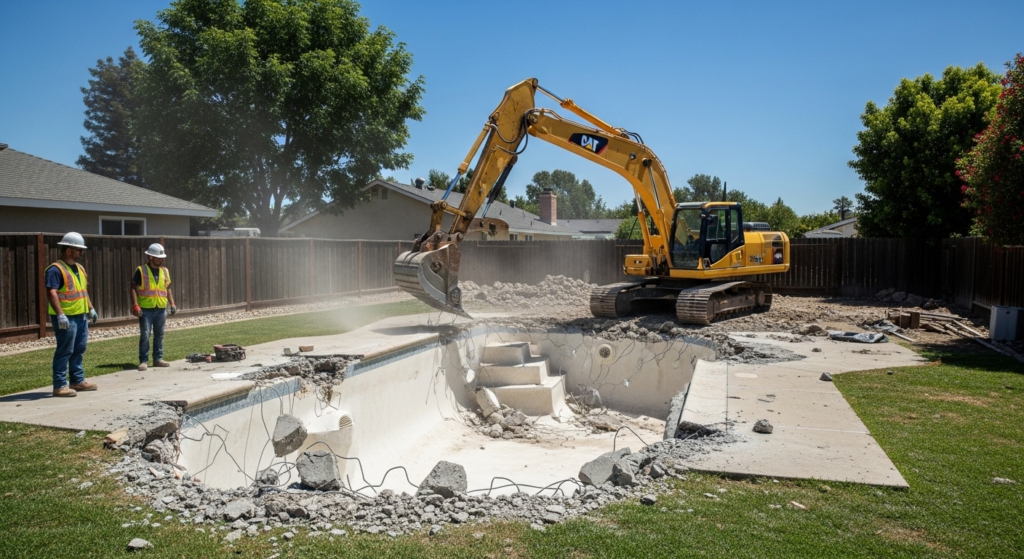
Pool demolition is the process of removing an existing swimming pool — either partially or completely — from a residential or commercial property. It involves breaking down the pool structure, removing debris, filling the void with compacted material, and restoring the ground surface.
Understanding pool demolition cost matters for several reasons. First, an unused pool is a liability. It increases your homeowner’s insurance premium, requires ongoing chemical and maintenance expenses, and poses a safety risk — especially for families with young children. Second, removing a pool can significantly increase your usable yard space and, in many markets, raise your property value.
If you are in the Bay Area, companies like Bye Bye Pools by Cicarelli Contractor specialize in exactly this kind of work, handling everything from permits to final grading with a professional team that has earned consistent five-star reviews from local homeowners.
According to the National Association of Realtors, a pool can add value in warm climates but may actually deter buyers in cooler regions — making removal a smart move for resale in many parts of the country.
Average Pool Demolition Cost in the US
The average pool demolition cost in the United States ranges from $5,000 to $19,000, depending on the removal method, pool size, material type, and local labor rates. A partial fill-in typically costs $5,000 to $9,000, while a full pool removal ranges from $9,000 to $19,000 or more for large or complex structures.
The table below gives you a clear breakdown of what to expect based on pool type and removal method.
| Pool Type | Removal Method | Average Cost Range |
|---|---|---|
| Above-ground pool | Full removal | $300 – $800 |
| Small in-ground (vinyl/fiberglass) | Partial fill-in | $5,000 – $7,500 |
| Mid-size in-ground (concrete) | Partial fill-in | $6,500 – $9,000 |
| Large in-ground (concrete) | Full removal | $10,000 – $19,000 |
| Pool with spa or water features | Full removal | $12,000 – $25,000+ |
| Olympic or commercial pool | Full removal | $20,000 – $50,000+ |
These figures represent national averages. In high-cost-of-living areas like the San Francisco Bay Area, pool demolition cost tends to run 15 to 30 percent higher than the national average due to labor rates, permit fees, and disposal costs.
Partial Pool Removal vs. Full Pool Removal: Which Costs Less?
One of the most important decisions you will make is whether to pursue a partial or full pool removal. Each method has a different pool demolition cost profile, and each comes with trade-offs you need to understand before signing a contract.
What Is Partial Pool Removal (Pool Fill-In)?
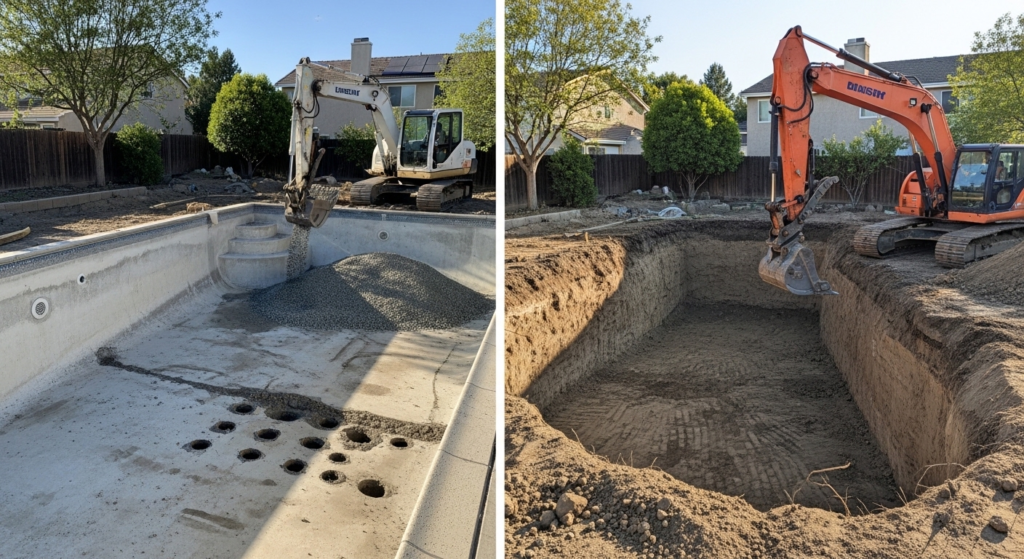
Partial pool removal — also called a pool fill-in or pool abandonment — involves breaking holes in the bottom of the pool for drainage, demolishing the upper walls, and filling the remaining shell with gravel, dirt, and compacted soil. The concrete shell stays partially in the ground.
This method is faster and less expensive, making it the most popular choice for homeowners focused on minimizing pool demolition cost. However, it comes with a disclosure requirement in most states: when you sell the property, you must inform buyers that a pool was filled in on the premises. Some lenders may also restrict financing on properties with partially removed pools.
What Is Full Pool Removal (Complete Excavation)?
Full pool removal means the entire pool structure — concrete, plumbing, steel, and all — is excavated and hauled away. The hole is then filled with clean, compacted fill material and graded to match the surrounding yard.
Full removal costs more upfront, but it eliminates disclosure requirements, gives you a clean slate for landscaping or construction, and is often required if you plan to build a structure over the former pool area. If you are planning an outdoor living space addition or a home extension, full removal is almost always the right call.
Comparison: Partial vs. Full Pool Removal
| Factor | Partial Removal | Full Removal |
|---|---|---|
| Average cost | $5,000 – $9,000 | $9,000 – $19,000+ |
| Time to complete | 2–5 days | 3–7 days |
| Disclosure required at sale | Yes (in most states) | No |
| Suitable for building over | No | Yes |
| Soil settling risk | Moderate | Low |
| Permit required | Usually yes | Yes |
What Factors Affect Pool Demolition Cost?
Pool demolition cost is not a flat rate. Multiple variables influence the final number on your invoice. Understanding these factors helps you ask the right questions when getting quotes and avoid being caught off guard by unexpected charges.
Pool Size and Depth
Larger pools require more labor, more equipment time, and more fill material. A 12×24 foot pool will cost significantly less to remove than a 20×40 foot pool. Depth also matters — deeper pools mean more excavation and more debris to haul away.
Pool Material
The material your pool is made of directly impacts demolition difficulty and cost:
- Concrete or gunite pools are the most expensive to demolish because the material is dense and requires heavy equipment to break apart.
- Fiberglass pools are easier to remove in one piece or large sections, which can reduce labor time.
- Vinyl liner pools have a steel or polymer frame that is relatively straightforward to dismantle, making them the least expensive in-ground option to remove.
Location and Accessibility
If your pool is in a tight backyard with limited equipment access, contractors may need to use smaller machinery or perform more work by hand — both of which increase labor costs. Properties in urban areas or on hillsides, common in the Bay Area near Richmond, CA, often face higher pool demolition costs for this reason.
Permit Fees
Most municipalities require a demolition permit before pool removal can begin. Permit fees vary widely — from $100 in rural areas to $500 or more in cities like San Francisco or Oakland. Your contractor should handle the permit process, but the cost is typically passed on to you. The team at Cicarelli Contractor manages all permitting as part of their full-service pool demolition offering, so you never have to navigate city hall on your own.
Debris Disposal and Hauling
Concrete, steel rebar, plumbing pipes, and fill material all need to be transported to a disposal facility. Disposal fees depend on the volume of material and local tipping fees. In California, disposal costs can be notably higher due to environmental regulations.
Soil Conditions and Backfill
Rocky soil, high water tables, or unstable ground can complicate excavation and increase costs. The quality of backfill material also matters — using clean, compacted gravel and soil reduces the risk of future settling, which protects your investment long-term.
Additional Features
Pools with attached spas, waterfalls, retaining walls, or elaborate decking will cost more to demolish. Each additional feature adds labor time and disposal volume to the project.
Hidden Costs of Pool Demolition You Need to Know
Many homeowners are surprised by costs that were not included in their initial quote. Here are the most common hidden expenses associated with pool demolition cost:
Utility disconnection fees: Gas, electric, and water lines connected to the pool must be properly capped or disconnected by licensed tradespeople. This can add $200 to $800 to your total.
Landscaping and restoration: After demolition, the area will need grading, topsoil, and possibly seeding or sod installation. Basic restoration can cost $500 to $3,000 depending on the size of the area.
Fence removal and reinstallation: If a safety fence surrounds your pool, it may need to be removed and reinstalled or replaced entirely.
Asbestos or hazardous material testing: Older pools built before the 1980s may contain materials that require special handling. Testing and remediation can add $500 to $2,000 or more.
Structural inspection: Some lenders or buyers may require a structural inspection of the filled area before approving financing. Budget $300 to $600 for this.
To avoid surprises, always ask your contractor for a fully itemized quote. At Bye Bye Pools, the team provides transparent, detailed estimates so you know exactly what you are paying for before any work begins.
Pool Demolition Cost by State and Region
Pool demolition cost varies significantly across the United States. Here is a general regional breakdown to help you calibrate your expectations:
Regional Pool Demolition Cost Averages
| Region | Partial Removal Avg. | Full Removal Avg. |
|---|---|---|
| Northeast (NY, NJ, CT) | $7,000 – $10,000 | $12,000 – $20,000 |
| Southeast (FL, GA, SC) | $5,000 – $8,000 | $9,000 – $15,000 |
| Midwest (OH, IL, MI) | $5,000 – $7,500 | $8,000 – $14,000 |
| Southwest (TX, AZ, NV) | $5,500 – $8,500 | $9,000 – $16,000 |
| West Coast (CA, OR, WA) | $7,500 – $11,000 | $13,000 – $22,000 |
| Bay Area, CA (specific) | $8,000 – $12,000 | $14,000 – $25,000 |
The Bay Area consistently ranks among the highest-cost regions for pool demolition due to elevated labor rates, strict permitting requirements, and higher disposal fees. If you are located in Richmond, Oakland, San Jose, or surrounding communities, working with a locally established contractor like Cicarelli Contractor ensures you get accurate local pricing and a team that understands Bay Area regulations.
Real Customer Stories: What Bay Area Homeowners Paid
Nothing illustrates pool demolition cost better than real-world examples. Here are stories from homeowners who worked with Cicarelli Contractor and Bye Bye Pools in the Bay Area.
Case Study 1: Richmond, CA — Concrete Pool Full Removal
A homeowner in Richmond, CA had a 16×32 foot gunite pool that had not been used in over a decade. The pool was cracked, the equipment was failing, and the family wanted to convert the space into a vegetable garden and patio area. They chose full pool removal.
Total pool demolition cost: $16,400, which included permits, full excavation, debris hauling, compacted backfill, and basic grading. The project was completed in five days. The homeowner later added an outdoor living space on the reclaimed area, which added significant value to the property.
“The team was professional, on time, and cleaned up everything perfectly. I was nervous about the cost, but they walked me through every line item. No surprises.” — Verified Google Review, Richmond, CA
Case Study 2: Oakland, CA — Partial Fill-In for Resale Prep
An Oakland homeowner preparing to sell their property chose partial pool removal to minimize cost and speed up the timeline. Their 14×28 foot vinyl liner pool was filled in over three days.
Total pool demolition cost: $7,200, including permits, partial demolition, fill material, and compaction. The homeowner disclosed the fill-in to buyers as required by California law. The property sold within two weeks of listing.
“Fast, clean, and exactly what they quoted. I appreciated that they handled the permit so I didn’t have to deal with the city.” — Verified Review, Oakland, CA
Case Study 3: San Jose, CA — Pool with Spa Removal
A San Jose family had a 20×40 foot concrete pool with an attached spa and waterfall feature. They wanted the full yard reclaimed for their children to play in. Full removal was the only option.
Total pool demolition cost: $23,800, which included the spa demolition, waterfall removal, utility disconnection, full excavation, and premium backfill with compaction testing. The project took seven days.
“Worth every penny. The yard looks amazing and the kids finally have space to run around. Cicarelli’s crew was respectful of our property the entire time.” — Verified Google Review, San Jose, CA
How to Save Money on Pool Demolition Cost
You do not have to pay top dollar to get quality pool removal. Here are practical strategies to reduce your pool demolition cost without cutting corners on safety or quality.
Get at least three quotes. Prices vary between contractors. Collecting multiple bids gives you leverage and a realistic sense of the market rate in your area. Use resources like Angi or HomeAdvisor to find vetted local contractors alongside direct outreach to specialists like Bye Bye Pools.
Choose partial removal if you have no plans to build. If you are not planning to construct anything over the former pool area, partial fill-in is a legitimate and cost-effective option that can save you $4,000 to $10,000.
Schedule during the off-season. Contractors are often less busy in fall and winter, which can translate to better pricing and faster scheduling. Pool demolition cost may be negotiable during slower months.
Bundle with other projects. If you are also planning a remodel, painting project, or excavation work, bundling services with one contractor can reduce mobilization costs. Cicarelli Contractor offers a full range of services including remodeling, painting, and hard demolition, making it easy to combine projects efficiently.
Ask about referral discounts. Some contractors, including Cicarelli Contractor, offer referral programs that can reduce your cost. Check out their referral program here.
Verify what is included. Always confirm that permits, hauling, backfill, and grading are included in the quoted price. A low headline number that excludes these items can end up costing more than a higher all-inclusive quote.
Common Mistakes Homeowners Make When Budgeting for Pool Demolition
Avoiding these errors can save you thousands of dollars and weeks of frustration.
Choosing the cheapest bid without vetting the contractor. Unlicensed or underinsured contractors may offer low prices but expose you to serious liability if something goes wrong. Always verify licensing, insurance, and references before signing anything.
Not pulling permits. Skipping the permit process might seem like a way to save money, but unpermitted work can create major problems when you sell your home. In California, unpermitted pool removal can result in fines and required remediation.
Underestimating backfill quality. Using poor-quality fill material leads to soil settling over time, which can damage landscaping, patios, or structures built over the area. Always ask your contractor what type of fill material they use and whether compaction testing is included.
Ignoring utility lines. Failing to properly disconnect or cap pool-related utilities before demolition can result in damage, safety hazards, and costly repairs.
Not planning for what comes next. Pool demolition is the beginning, not the end. Have a plan for what you will do with the reclaimed space — whether that is lawn, a patio, a garden, or an addition. Planning ahead helps you coordinate with your contractor and avoid double mobilization fees.

The Pool Demolition Process: Step by Step
Understanding what actually happens during a pool removal project helps you set realistic expectations and communicate effectively with your contractor.
Step 1: Site Assessment and Permit Application
Your contractor visits the property, assesses the pool size, material, access conditions, and utility connections. They then apply for the required demolition permit from your local municipality. In the Bay Area, this process typically takes one to three weeks.
Step 2: Utility Disconnection
All electrical, gas, and water connections to the pool and its equipment are safely disconnected or capped by licensed tradespeople before any demolition begins.
Step 3: Pool Draining
The pool is fully drained. In California, pool water must be discharged in compliance with local water authority regulations — typically to the sanitary sewer, not the storm drain.
Step 4: Demolition
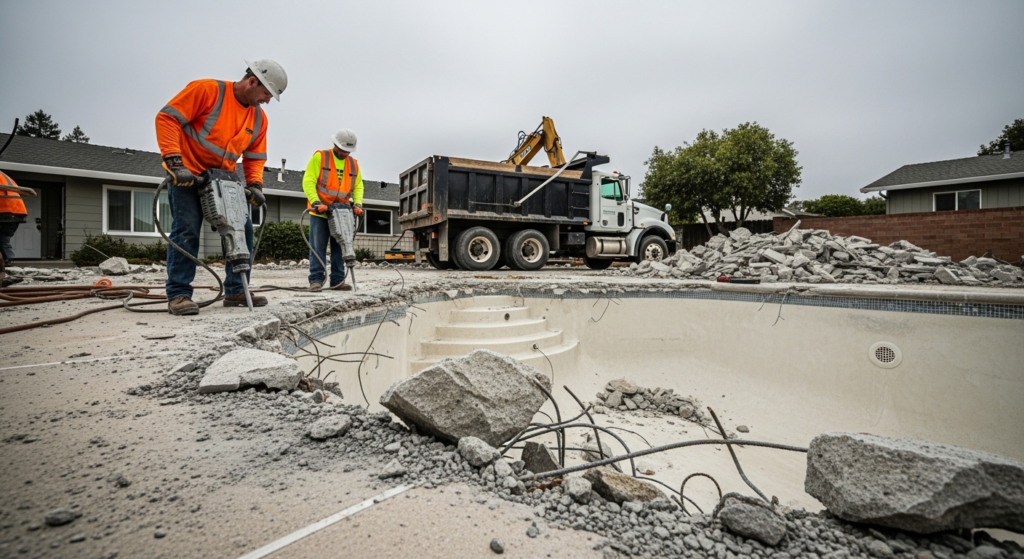
For partial removal, the crew breaks holes in the pool floor for drainage and demolishes the upper walls. For full removal, heavy equipment breaks apart the entire shell and excavates the structure from the ground.
Step 5: Debris Removal
All concrete, rebar, plumbing, and equipment are loaded and hauled to a licensed disposal facility. This is a significant component of pool demolition cost, particularly for large concrete pools.
Step 6: Backfill and Compaction
The void is filled in layers with approved fill material — typically a combination of gravel and clean soil — and compacted at each layer to minimize future settling.
Step 7: Final Grading and Inspection
The surface is graded to match the surrounding yard. A final inspection is conducted by the local building department to close out the permit. Your contractor provides you with the signed permit documentation for your records.
The hard demolition and excavation team at Cicarelli Contractor follows this exact process on every project, ensuring compliance, safety, and a clean result every time.
Is Pool Demolition Worth the Cost?
This is the question most homeowners wrestle with before committing to a project. The honest answer depends on your specific situation, but the data strongly supports removal in many cases.
Ongoing maintenance costs: The average American homeowner spends $1,200 to $1,800 per year on pool maintenance — chemicals, cleaning, equipment repairs, and winterization. Over ten years, that is $12,000 to $18,000 in operating costs alone, not counting major repairs.
Insurance savings: Removing a pool can reduce your homeowner’s insurance premium by $50 to $100 per month in some cases, depending on your insurer and location.
Property value impact: In cooler climates and markets where pools are not a selling point, removal can actually increase buyer interest and reduce time on market. A study by the National Association of Realtors found that outdoor space improvements consistently rank among the top value-adding projects for resale.
Safety and liability: An unused pool is a drowning hazard and a legal liability. Removing it eliminates that risk entirely.
When you factor in the long-term savings on maintenance, insurance, and liability, the pool demolition cost often pays for itself within five to seven years.
Why Choose Bye Bye Pools and Cicarelli Contractor?
If you are in the San Francisco Bay Area — including Richmond, Oakland, San Jose, Fremont, Concord, or surrounding communities — Bye Bye Pools by Cicarelli Contractor is the region’s trusted specialist for pool demolition and removal.
Located at Richmond, CA 94805, the team brings years of hands-on experience, full licensing and insurance, and a reputation built on transparent pricing and quality workmanship. They handle every aspect of the project — permits, demolition, hauling, backfill, and grading — so you never have to coordinate multiple contractors.
Customers consistently highlight the team’s professionalism, communication, and clean job sites in their reviews:
“I was dreading this project, but the Cicarelli team made it completely painless. They showed up on time every day, kept me informed, and the yard looked better than I expected when they were done.” — Google Review, Fremont, CA
“Fair price, honest people, excellent work. They explained the whole process before starting and delivered exactly what they promised.” — Google Review, Concord, CA
“We got three quotes and Cicarelli was not the cheapest, but they were the most thorough and professional. Absolutely worth it.” — Google Review, Oakland, CA
You can learn more about the company’s values, team, and service standards on the About page, and explore their full range of services — from remodeling to outdoor living spaces — at cicarellicontractor.
For warranty and maintenance information after your project is complete, visit the warranty and maintenance page.
Frequently Asked Questions About Pool Demolition Cost
How much does it cost to demolish an in-ground pool?
The average pool demolition cost for an in-ground pool in the United States ranges from $5,000 for a small partial fill-in to $19,000 or more for a full removal of a large concrete pool. In high-cost areas like the Bay Area, prices typically run 15 to 30 percent higher than the national average.
What is the cheapest way to remove a pool?
The least expensive option is a partial pool removal, also called a fill-in, which typically costs $5,000 to $9,000. This method leaves the lower portion of the pool shell in the ground and fills the rest with compacted material. It is a legitimate option for homeowners who do not plan to build over the area and are comfortable with the required disclosure at resale.
Does removing a pool increase property value?
It depends on your market and climate. In cooler regions or markets where pools are not a selling feature, removing a pool can increase buyer interest and reduce time on market. In warm-weather markets like Florida or Arizona, a pool may add value. Consulting a local real estate agent before making the decision is always a good idea.
How long does pool demolition take?
Most residential pool demolition projects take between two and seven days, depending on the size of the pool, the removal method, and site conditions. Permit processing time — which can take one to three weeks — is separate from the actual construction timeline.
Do I need a permit to remove a pool?
Yes, in virtually all US jurisdictions, a permit is required to demolish and fill in a swimming pool. Your contractor should handle the permit application as part of their service. Working without a permit can result in fines and complications when selling your home. The team at Bye Bye Pools manages all permitting as a standard part of every project.
Is pool demolition covered by homeowner’s insurance?
In most cases, pool demolition is not covered by homeowner’s insurance unless the removal is necessitated by a covered event such as structural damage from a natural disaster. Standard elective pool removal is considered a home improvement project and is paid out of pocket.
Conclusion: Know Your Pool Demolition Cost Before You Commit
Understanding pool demolition cost before you start calling contractors puts you in a position of confidence and control. You now know that the national average ranges from $5,000 for a basic partial fill-in to $19,000 or more for a full removal of a large concrete pool. You know what factors drive costs up — pool size, material, access, permits, and disposal — and what hidden fees to watch for. You know the difference between partial and full removal, and you have a clear picture of the step-by-step process.
Most importantly, you know that the long-term financial case for pool removal is often stronger than it appears at first glance. When you factor in ongoing maintenance, insurance savings, and the value of reclaimed outdoor space, the pool demolition cost frequently pays for itself within a few years.
If you are ready to take the next step, the team at Bye Bye Pools by Cicarelli Contractor is here to help. Serving Richmond, Oakland, San Jose, Fremont, Concord, and communities throughout the Bay Area, they offer transparent pricing, full-service project management, and a track record of five-star results.
Call us at (650) 404-7049, email info@cicarellicontractor.
Get your free pool demolition quote today — and take the first step toward reclaiming your backyard.
Company Information Cicarelli Contractor / Bye Bye Pools Richmond, CA 94805 Phone: (650) 404-7049 Email: info@cicarellicontractor.
