
The excavation vs grading difference Bay Area projects demand is one of the most misunderstood topics in residential construction — and getting it wrong costs homeowners thousands of dollars. If you’re planning a pool removal in Richmond, a new patio in Oakland, or a foundation prep in San Jose, knowing exactly what separates these two services is the first decision you need to make. This guide breaks down everything: definitions, costs, permits, real project examples, and when you need one, the other, or both. Continue reading to plan your Bay Area project with confidence.
Whether you’ve already gotten contractor bids that seem inconsistent, or you’re just starting to research, understanding the excavation vs grading difference Bay Area projects involve helps you ask the right questions, compare quotes accurately, and avoid expensive mistakes.
Ready to get a professional assessment for your property? Request a free estimate from Cicarelli Contractors today.
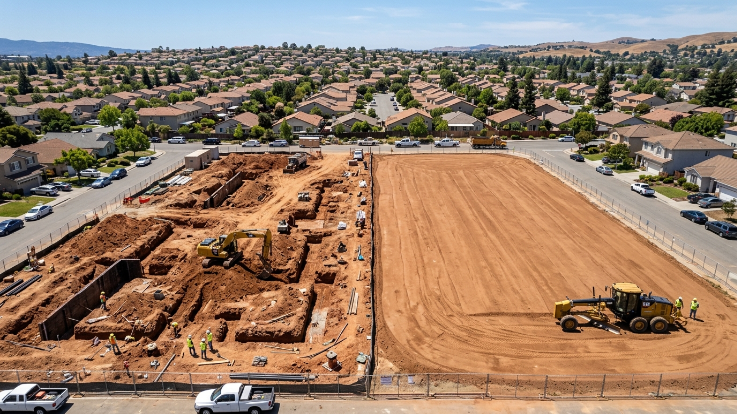
What Is the Excavation vs Grading Difference Bay Area Projects Deal With Most?
When contractors and homeowners discuss site preparation, the excavation vs grading difference Bay Area projects face comes down to two fundamentally different operations. One goes deep into the ground. The other reshapes what’s already on the surface.
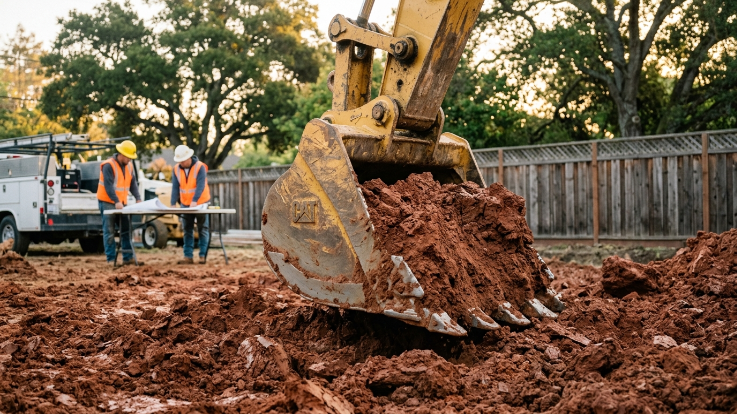
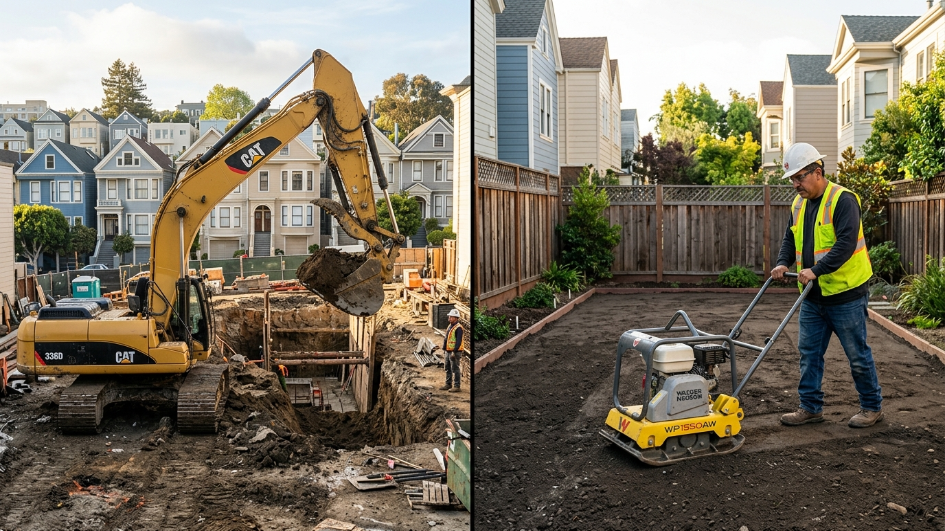
Excavation is the process of digging into the earth to remove soil, rock, or other materials to a specific depth. It creates space for foundations, utility lines, drainage systems, retaining walls, and pool removal. Excavation goes down — it removes material from below the existing surface.
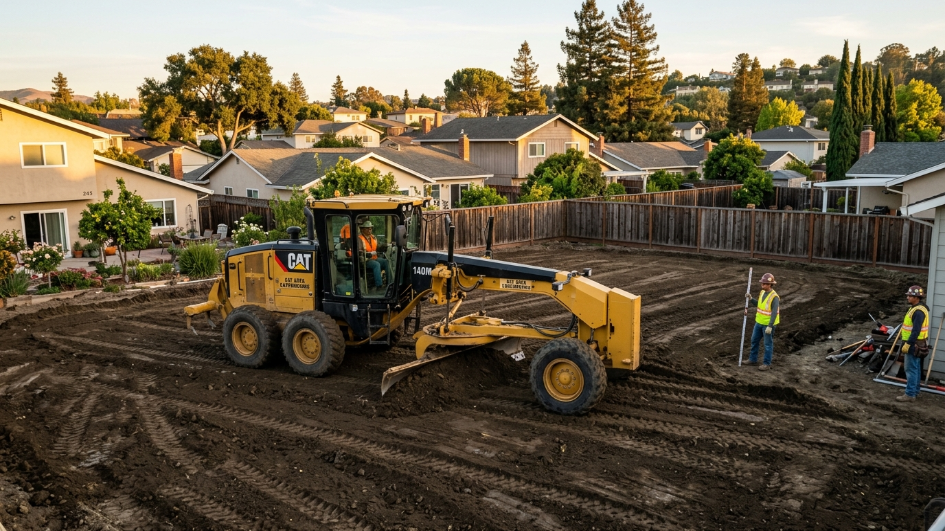
Grading, on the other hand, is the process of reshaping and leveling the surface of the land. It moves existing soil horizontally to create a flat, sloped, or contoured surface for proper drainage and construction readiness. Grading works across the surface — redistributing what’s already there.
The most practical way to remember the excavation vs grading difference Bay Area projects contractors explain daily: excavation removes, grading redistributes.
Excavation Defined
Excavation involves heavy equipment like backhoes, excavators, and bulldozers digging into the ground to a pre-determined depth. In Bay Area projects, this commonly applies to:
- Pool demolition and removal
- Foundation trenching for new structures
- Utility and drainage line installation
- Basement or below-grade space creation
- Retaining wall base preparation
The soil removed during excavation is hauled away or stockpiled for later use. When Cicarelli Contractors handles a pool demolition in the Bay Area, excavation is typically the first major phase — removing the shell, draining systems, and surrounding concrete before backfilling and compacting.
Grading Defined
Grading uses equipment like motor graders, box blades, and compactors to level and shape the land surface. Bay Area grading projects typically cover:
- Leveling a yard before landscaping or patio installation
- Creating proper drainage slopes away from a home’s foundation
- Preparing a pad for a driveway, garage, or ADU
- Restoring a yard after pool removal or demolition work
- Rough grading before paving or hardscaping
Grading is often the final site prep step after excavation is complete — but it can also be a standalone service when the ground simply needs reshaping. Understanding this sequence is central to the excavation vs grading difference Bay Area projects require from start to finish.
Why the Excavation vs Grading Difference Matters for Bay Area Projects
The Bay Area’s unique geology and climate make this distinction especially important. The excavation vs grading difference Bay Area projects deal with is shaped by regional factors that don’t apply the same way in other states.
Bay Area Soil Conditions
The Bay Area sits on a complex mix of expansive clay soils (especially in the East Bay), sandy fill in low-lying areas, and rocky terrain in the hills. This geology is exactly why the excavation vs grading difference Bay Area projects face goes beyond theory — soil behavior directly affects how each service must be executed. Expansive clay swells when wet and shrinks when dry — a cycle that causes foundation movement and drainage problems if grading slopes aren’t correctly engineered.
Excavation in clay-heavy soil requires specific equipment and careful wall-shoring to prevent collapse. Grading in these soils demands precise slope calculations — typically a 2% minimum grade away from structures, per California building standards — to manage the Bay Area’s wet winters. Any contractor who doesn’t understand the excavation vs grading difference Bay Area projects like these require will likely underestimate both the equipment and the engineering involved.
Permit Requirements
In cities like Richmond, Oakland, San Jose, and San Francisco, both excavation and grading often require separate permits. The California Building Code sets thresholds: generally, any grading that moves more than 50 cubic yards of soil requires a grading permit. Excavation for foundations always requires a building permit.
Cicarelli Contractors manages permitting as part of every project. You can review their full service scope on the services page.
Seismic Considerations
The Bay Area’s proximity to the Hayward and San Andreas faults adds a layer of complexity. Excavation near fault zones requires geotechnical reports in many jurisdictions. Grading on hillside lots must account for slope stability and liquefaction risk. Working with a licensed contractor who understands the excavation vs grading difference Bay Area projects face seismically is non-negotiable.
5 Key Differences Between Excavation and Grading for Bay Area Projects
This table captures the core of the excavation vs grading difference Bay Area projects need to understand before budgeting or hiring:
| Factor | Excavation | Grading |
|---|---|---|
| Primary purpose | Remove soil/material from depth | Reshape and level the surface |
| Direction of work | Vertical (downward) | Horizontal (surface level) |
| Equipment used | Excavators, backhoes, trenchers | Motor graders, compactors, box blades |
| Material disposal | Soil hauled away or stockpiled | Soil redistributed on-site |
| Typical Bay Area cost | $50–$200 per cubic yard | $500–$5,000+ depending on area |
| Permit required? | Almost always | Often (50+ cubic yards threshold) |
| Project phase | Early — before grading | Mid to late — after excavation |
Understanding these five differences helps you communicate clearly with contractors, get accurate bids, and avoid paying for services you don’t need — or missing ones you do.
When Do Bay Area Projects Need Excavation?
Excavation is required any time your project needs to go below the existing ground surface. Recognizing the excavation vs grading difference Bay Area projects involve starts with knowing the scenarios that require each:
- Pool removal: Old in-ground pools must be excavated before the shell can be demolished and the pit backfilled. Cicarelli Contractors specializes in professional pool demolition and removal services across the Bay Area.
- Foundation work: New home additions, ADUs, and garages all require excavated foundations.
- Drainage systems: French drains, dry wells, and underground downspout extensions need trenching.
- Utility lines: Water, sewer, electrical conduit, and gas lines run underground — all requiring precision excavation.
- Retaining walls: The base footings for retaining walls on sloped Bay Area lots need excavation.
If your project involves any of these elements, excavation comes first. The hard demolition and excavation services at Cicarelli Contractors cover all these scenarios with licensed operators and proper equipment.
When Do Bay Area Projects Need Grading?
Grading is needed when the goal is surface-level land preparation. You’ll need grading when:
- A pool has been removed and the backfilled pit needs to be leveled and compacted to match the surrounding yard
- You’re installing a new patio, deck, or outdoor living space and need a level, stable surface
- The existing yard drains water toward your foundation instead of away from it
- You’re seeding or sodding a lawn and need an even base
- A driveway or parking pad needs a compacted, properly sloped base
Many Bay Area homeowners underestimate how much their yard’s drainage affects their home’s long-term structural health. A yard that slopes even 1% toward the foundation sends significant water volume toward your home during wet winters. Proper grading solves this permanently — and it’s a key part of the excavation vs grading difference Bay Area projects often discover only after problems appear.
Real Bay Area Project Case Studies
Case Study 1 — Pool Removal in Richmond, CA
A homeowner in Richmond had a 20-year-old in-ground gunite pool that was cracking, no longer used, and consuming $300/month in maintenance. The project required two distinct phases illustrating the full excavation vs grading difference Bay Area projects go through: first, full excavation to break up and remove the pool shell, plumbing, and equipment pad — approximately 85 cubic yards of material. Second, grading to compact the backfilled area and restore a usable, level lawn.
Cicarelli Contractors completed the project in under two weeks, including permit filing and final compaction certification.
“I was nervous about the whole process, but the team walked me through every step. The yard looks completely natural — you’d never know there was a pool there.” — Verified Google Review, Richmond, CA
Case Study 2 — ADU Foundation Prep in Oakland
An Oakland homeowner needed an ADU (Accessory Dwelling Unit) built on a sloped rear yard. The project required excavation to cut into the hillside and create a level building pad, followed by grading to establish proper drainage and a compacted base for the foundation. Without both services in sequence, the ADU would have faced serious drainage and structural issues.
This project illustrates why understanding the excavation vs grading difference Bay Area projects require isn’t just academic — the sequence and scope directly affect long-term safety and code compliance. You can explore more about Cicarelli’s approach on their about page.
Have a project in mind? Talk to the Cicarelli Contractors team today and get a free, itemized estimate — (650) 404-7049.
How Much Does Excavation vs Grading Cost in the Bay Area?
Cost is one of the most searched aspects of the excavation vs grading difference Bay Area projects face. Here’s what to expect in current Bay Area market conditions:
Excavation Costs
- Residential excavation: $1,500–$15,000+ depending on depth, soil type, and scope
- Pool removal excavation: $3,000–$9,000 for most residential pools
- Utility trenching: $30–$75 per linear foot
- Rock excavation: significantly higher due to equipment requirements
Grading Costs
- Basic yard grading (small lot): $500–$1,500
- Full yard re-grade with drainage: $2,000–$7,000
- Driveway pad grading: $800–$2,500
- Post-pool-removal grading and compaction: $1,000–$3,000
These are Bay Area market estimates. Final pricing depends on lot size, access difficulty, soil conditions, permit fees, and haul-away requirements. Always request an itemized estimate that separates excavation labor, equipment, disposal, and grading work. You can also check resources like Angi and HomeAdvisor for regional cost benchmarks.
Get a free, itemized estimate from Cicarelli Contractors here.
5 Common Mistakes Bay Area Homeowners Make
Applying the excavation vs grading difference Bay Area projects involve also means knowing what goes wrong when homeowners skip steps or hire the wrong contractor.
Mistake 1: Grading Before Compaction Is Complete
After excavation backfill, the soil must compact and settle before final grading. Rushing this step leads to uneven surfaces, sinkholes, and failed lawn installations.
Mistake 2: Ignoring Drainage Slope Requirements
California requires a minimum 5% grade for the first 10 feet away from a structure (IRC Section R401.3). Many DIY grading attempts don’t achieve this, directing water toward foundations.
Mistake 3: Not Pulling Permits
Both excavation and grading often require permits in Bay Area municipalities. Unpermitted work can result in fines, required demolition, and complications when selling the property. Learn more about compliance via Cicarelli’s remodeling services page.
Mistake 4: Combining Estimates Without Itemization
Some contractors quote a single “site prep” number that bundles excavation, grading, disposal, and compaction. Always ask for line-item breakdowns so you can compare bids accurately.
Mistake 5: Underestimating Soil Disposal Costs
Excavated soil — especially contaminated or clay-heavy fill — costs money to haul and dispose of properly. Bay Area disposal fees can add $500–$3,000 to a project depending on volume and soil classification.
Frequently Asked Questions
Q1: What is the main excavation vs grading difference for Bay Area projects?
Excavation removes soil from below the ground surface to a specific depth, while grading reshapes and levels the existing surface horizontally. In Bay Area projects, the excavation vs grading difference is that excavation happens first — for foundations, pool removal, or utilities — and grading follows to prepare the final surface.
Q2: Do I need both excavation and grading for a pool removal project in the Bay Area?
Yes, in most cases. Pool removal requires excavation to demolish and remove the pool structure, followed by grading to compact the backfilled area and create a level, stable yard. Skipping grading leads to uneven settling and drainage problems.
Q3: How long does excavation and grading take for a typical Bay Area project?
A standard pool removal with subsequent grading typically takes 5–10 business days. Larger projects involving foundation prep or extensive re-grading can take 2–4 weeks depending on permits, soil conditions, and project scope.
Q4: What permits are required for excavation and grading in the Bay Area?
Excavation for foundations almost always requires a building permit. Grading that moves more than 50 cubic yards requires a grading permit in most Bay Area jurisdictions. Cicarelli Contractors handles all permitting for their projects — visit the contact page to get started.
Q5: Can grading fix drainage problems around my Bay Area home’s foundation?
Yes. Proper grading that slopes away from your foundation at minimum 5% for the first 10 feet redirects water and reduces hydrostatic pressure against your foundation walls. It’s one of the most cost-effective long-term protections for your home.

Conclusion
Understanding the excavation vs grading difference Bay Area projects require is the foundation of any successful site preparation plan. Excavation removes material from depth — it’s the first step in pool removal, foundation work, and utility installation. Grading reshapes the surface — it’s the final step that creates drainage, levels the yard, and prepares land for whatever comes next.
In the Bay Area specifically, soil conditions, seismic requirements, permit rules, and steep lots make it especially important to work with a licensed contractor who understands both processes. Skipping steps, rushing compaction, or ignoring drainage slopes creates problems that cost far more to fix later than to do right the first time.
The excavation vs grading difference Bay Area projects need is exactly what Cicarelli Contractors is built to navigate. Their team serves homeowners across Richmond, Oakland, Berkeley, and the greater Bay Area with expert excavation, pool demolition, and outdoor living space services. They manage permits, operate the right equipment, and deliver inspection-ready results.
Ready to start your Bay Area project the right way? Contact Cicarelli Contractors today for a free estimate — (650) 404-7049 | info@cicarellicontractor.com | Mon–Fri 9 AM–5 PM | Sat 9 AM–2 PM | Richmond, CA 94805
Explore more on the Cicarelli Contractors blog, learn about their warranty and maintenance programs, or browse all available services.
