
Are you staring at a cracked, algae-covered pool that hasn’t been used in years?
You’re not alone.
Every year, thousands of Bay Area homeowners search for pool removal Bay Area what to expect — and for good reason.
A neglected pool drains your budget, raises your liability, and wastes valuable outdoor space.
This guide walks you through every step of the process — from the first phone call to the final layer of soil.
You’ll learn what it costs, how long it takes, what permits are required, and how to avoid the mistakes that derail most projects.
Continue reading to discover exactly how Cicarelli Contractors handles pool removal Bay Area what to expect from day one to project closeout.
Ready to start? Call (650) 404-7049 or request your free quote here. No pressure, no obligation.
What Is Pool Removal in the Bay Area — and What Does the Process Really Involve?
Understanding pool removal Bay Area what to expect starts with one important truth: this is not a weekend DIY project.
It is a structured demolition process that requires permits, heavy equipment, licensed contractors, and proper site restoration.
The Bay Area has specific environmental and structural regulations that affect how pools are removed.
Skipping any step can lead to legal headaches, soil problems, or failed home inspections years down the road.
There are two main types of pool removal:
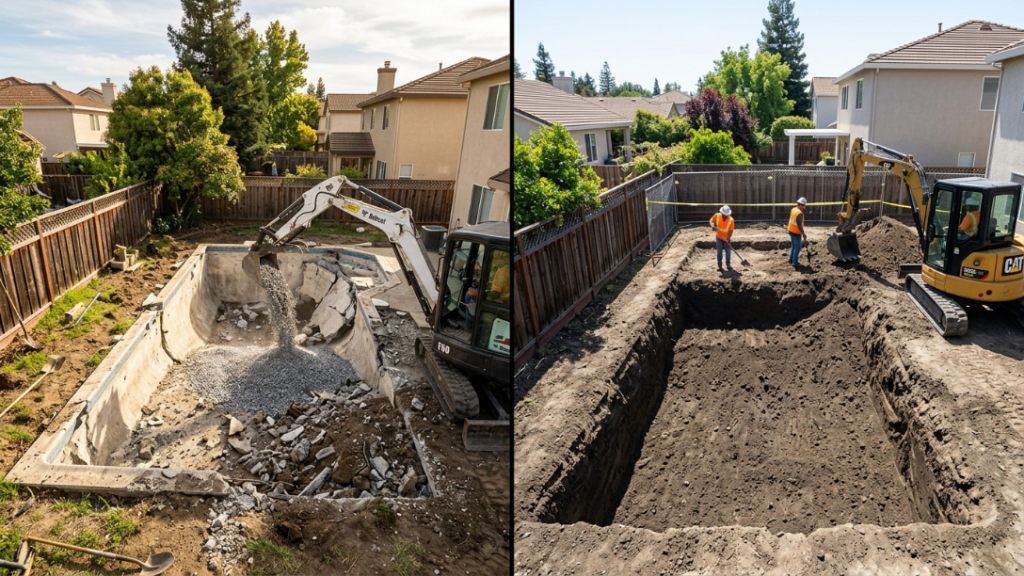
Partial removal (pool fill-in): The top portion of the pool shell is broken up and pushed into the cavity, then filled with gravel and soil. This is the more affordable option.
Full removal (complete excavation): The entire pool shell is excavated and hauled off-site. More expensive, but offers complete flexibility for future construction and adds more long-term value to the property.
Understanding which method fits your goals is the first conversation you should have with your contractor.
At Cicarelli Contractors, this consultation is free and tailored to your property’s specific layout and your long-term plans for the space.
Why Are So Many Bay Area Homeowners Removing Their Pools?
The demand for information on pool removal Bay Area what to expect keeps growing every season — and the reasons are practical, financial, and environmental.
Water scarcity: California’s ongoing drought cycles have made pool ownership increasingly expensive. Water bills for pool maintenance can run hundreds of dollars per month.
Maintenance costs: Between chemicals, equipment, heating, and cleaning services, a residential pool in the Bay Area can cost $3,000 to $5,000 per year just to stay operational.
Safety concerns: Families with young children or elderly residents often remove pools to eliminate drowning risks.
Liability insurance for homes with pools is also significantly higher.
Property reconfiguration: Many homeowners want their backyard space back.
Removing a pool opens up possibilities for ADUs, outdoor kitchens, patios, or landscaping — all of which may generate rental income or add resale value.
Unused assets: If a pool hasn’t been used in two or more years, it is actively costing money while delivering zero value.
If any of these reasons resonates, you’re already past the “if” and into the “how.”
Step-by-Step: Pool Removal Bay Area What to Expect at Every Stage
This is the core of what pool removal Bay Area what to expect means in practice.
Here is what a professional project looks like from day one through final inspection.
Step 1: Initial Consultation and Site Assessment
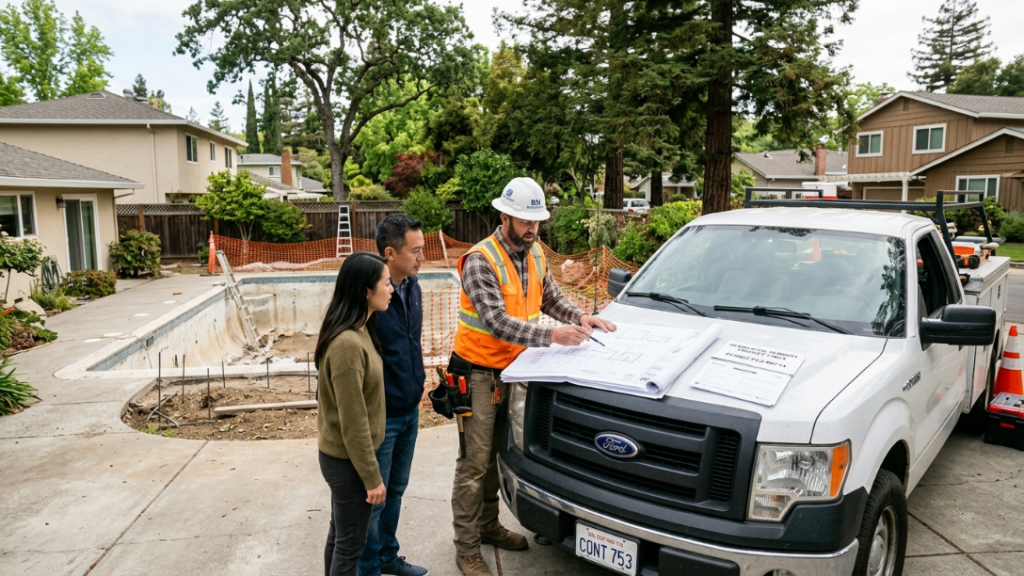
A licensed contractor visits your property to assess pool size, access points, soil conditions, and underground utilities.
They determine whether partial or full removal is appropriate and provide a detailed written estimate.
At Cicarelli Contractors, the assessment also includes a review of your long-term goals — lawn, patio, garden, or future construction — so the fill and grading plan supports those plans from the start.
Step 2: Permits and Local Approvals
This step is non-negotiable.
Pool removal in the Bay Area requires permits from your local city or county building department.
In most Bay Area jurisdictions — including Richmond, San Jose, Oakland, Fremont, and Walnut Creek — you’ll need a demolition permit and sometimes a grading permit.
The permit process typically takes 1 to 3 weeks, depending on the municipality.
Your contractor handles this on your behalf.
Skipping permits is one of the most common mistakes homeowners make — it can result in mandatory re-excavation, fines, and serious complications when selling the property.
Step 3: Utility Disconnection
Before any demolition begins, all utilities connected to the pool must be safely disconnected.
This includes:
- Electrical lines (pool pump, lighting, heater)
- Gas lines (if a gas heater is present)
- Plumbing (water supply and drainage lines)
Licensed electricians and plumbers handle these disconnections, and inspections are required before work proceeds.
Step 4: Draining the Pool
The pool is pumped completely dry.
In California, pool water cannot be discharged into street or storm drains due to chemical content.
Proper disposal follows state and local water authority guidelines — another critical reason why professional handling matters.
Step 5: Demolition and Excavation
This is where the heavy equipment comes in.
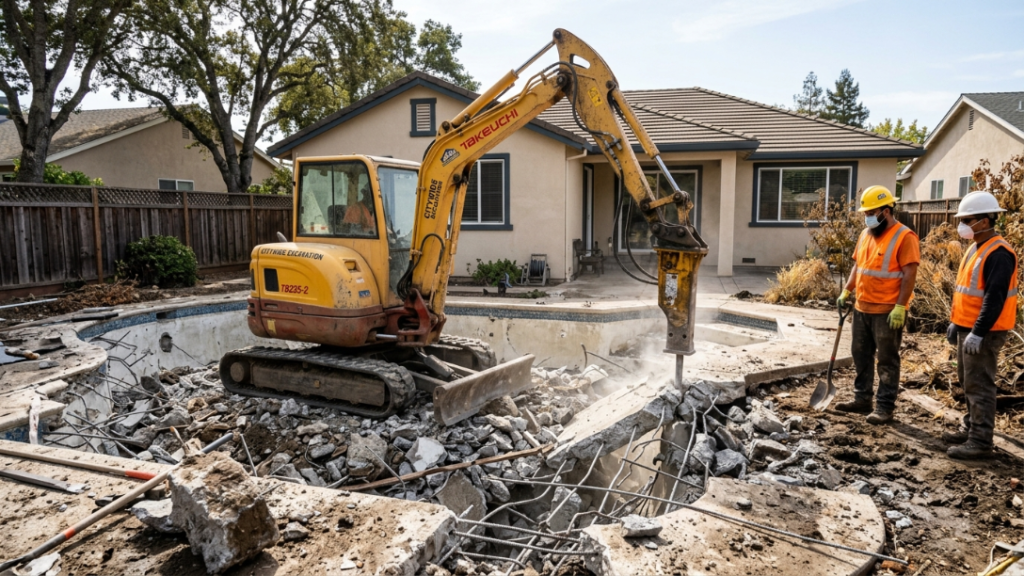
For partial removal, the pool shell walls are broken with a jackhammer or excavator and folded inward.
Holes are drilled in the bottom to ensure proper drainage, and the cavity is filled with approved materials in layers.
For full removal, the entire shell is excavated and removed from the site.
Cicarelli Contractors specializes in hard demolition and excavation across the Bay Area, using the right equipment and experienced crews to ensure clean, efficient execution.
Step 6: Backfill and Compaction
Filling the hole is not as simple as pushing dirt back in.
Proper backfilling uses layers of gravel and approved soil, compacted in stages to prevent future settling.
This is critical.
Improper compaction leads to sinkholes, uneven ground, and structural issues that can affect anything built on that land for decades.
A compaction report is often required by the city and is essential if you ever plan to build on the site.
Step 7: Soil Grading and Site Restoration
Once the fill is compacted, the surface is graded to blend with the surrounding yard.
Drainage is planned so water flows away from the home’s foundation.
Topsoil is added and the area is prepared for whatever comes next — seeding, sod, hardscape, or construction.
Step 8: Final Inspection
A city inspector signs off on the work, confirming the fill, compaction, and drainage meet local code.
You receive a final permit closure — an important document to keep for your property records and future real estate transactions.
How Much Does Pool Removal Cost in the Bay Area?
Cost is one of the first questions homeowners ask when researching pool removal Bay Area what to expect.
Here is a realistic breakdown:
| Type | Average Cost Range | Notes |
|---|---|---|
| Partial removal (fill-in) | $5,000 – $10,000 | Depends on pool size and access |
| Full removal | $10,000 – $20,000+ | Larger pools, tight access, complex soil |
| Permits | $200 – $1,500 | Varies by city/county |
| Utility disconnection | $300 – $1,000 | Electrical, gas, plumbing |
| Grading and restoration | $1,000 – $3,000 | Topsoil, seeding, or hardscape prep |
Several factors affect the final price: pool size, depth, materials (concrete, fiberglass, or vinyl), site accessibility, soil type, and your plans for the space afterward.
The best way to get an accurate number is to request a free quote.
You can reach Cicarelli Contractors at (650) 404-7049 or visit the contact page to schedule your free assessment.
Do I Need a Permit to Remove a Pool in the Bay Area?
Yes — and this is one of the most important things to understand about pool removal Bay Area what to expect.
Every city in the Bay Area requires at minimum a demolition permit.
Some cities also require a grading permit or a report from a licensed soil engineer.
Working without permits can result in:
- Stop-work orders and fines
- Required re-excavation to inspect fill quality
- Disclosure obligations that can kill real estate deals
- Insurance complications
A reputable contractor will always pull permits before starting work.
If a contractor offers to skip permits to save money, walk away.
What Happens to Your Yard After Pool Removal?
One of the best parts of completing the pool removal Bay Area what to expect process is seeing what your yard becomes.
Outdoor living space: A patio, pergola, fire pit, or outdoor kitchen can completely transform the area. Check out Cicarelli’s outdoor living space services for inspiration.
Landscaping: A lawn, garden beds, or native planting can bring life back to your yard and increase curb appeal.
ADU or structure foundation: Full removal opens the door to building a permitted structure on the footprint — significant added value in the Bay Area housing market.
Remodeling integration: Pool removal can be bundled with broader remodeling services to reduce mobilization costs if you’re already planning a renovation.

Real Stories: Bay Area Homeowners Who Made the Switch
Pool removal Bay Area what to expect is not just theoretical — it changes properties in real, measurable ways.
One homeowner in Richmond, CA shared on Google:
“Cicarelli Contractors removed our old pool and transformed the backyard into a usable space for our family. The team was professional, on time, and handled all the permits. The whole process took less than two weeks. I wish we had done it sooner.”
Another client in the East Bay noted:
“We were nervous about the disruption, but the crew was clean, respectful, and communicated every step. Our yard now has a beautiful patio where the pool used to be.”
These outcomes reflect the standard Cicarelli Contractors has built its reputation on.
You can read more reviews via Google Maps or connect on Facebook.
Common Mistakes to Avoid During Pool Removal
Even prepared homeowners make costly errors when approaching pool removal Bay Area what to expect.
Hiring unlicensed contractors: Always verify CSLB license status before signing any contract. California requires licensing for this type of work.
Choosing the cheapest bid without asking why: An unusually low bid almost always means cut corners — skipped permits, inadequate compaction, or improper disposal.
Not planning the space afterward: Restoration decisions affect how the fill is done. Deciding later to build on the space may mean additional costs if the original fill wasn’t compaction-tested.
Ignoring soil reports: In many Bay Area cities, an engineered compaction report is required. Even when not required, it’s worth requesting for your own protection.
Not disclosing to buyers: If you sell after removal, you must disclose the pool was removed and provide permit documentation. Missing this creates legal liability.
How Long Does Pool Removal Take?
For most standard projects, here is a realistic timeline for pool removal Bay Area what to expect:
- Consultation and estimate: 1–3 days
- Permit approval: 1–3 weeks (varies by city)
- Utility disconnection: 1–2 days
- Demolition and excavation: 1–3 days
- Backfill and compaction: 1–2 days
- Grading and restoration: 1–2 days
- Final inspection: within 1–2 weeks after completion
Total active work time is typically 5 to 10 days. The permit process is usually the longest variable.
Why Choose Cicarelli Contractors for Pool Removal in the Bay Area?
Why Choose Cicarelli Contractors for Pool Removal in the Bay Area?
When homeowners research pool removal Bay Area what to expect and start contacting companies, they quickly realize not all contractors are equal.
Cicarelli Contractors stands out for several clear reasons.
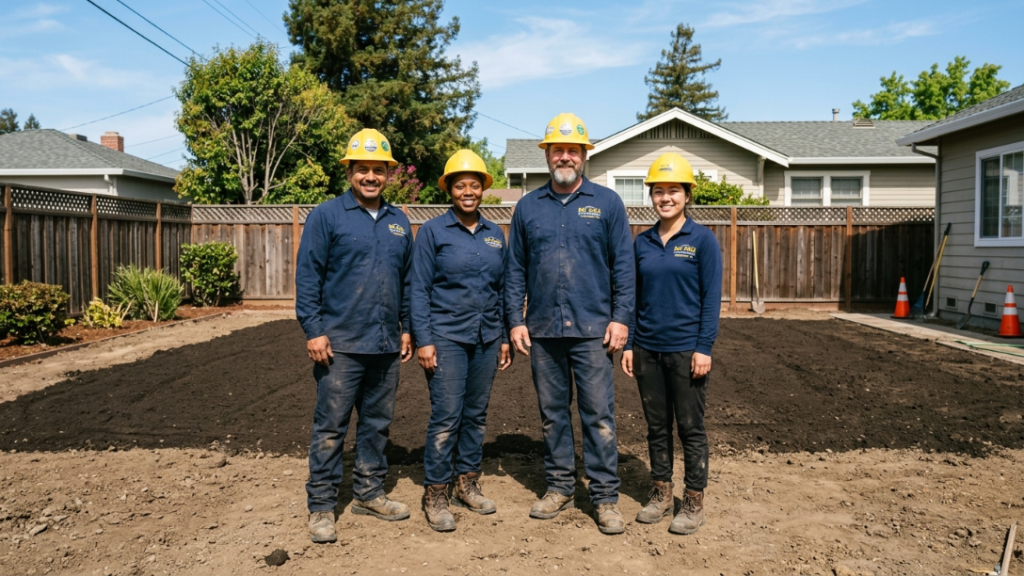
They are fully licensed and insured, compliant with all California contractor licensing requirements. Based in Richmond, CA, the team brings deep knowledge of Bay Area permit processes, soil conditions, and municipal requirements across the region — from the East Bay to the Peninsula.
From demolition to grading, painting, remodeling, and outdoor living, everything is handled under one roof. Post-project care is available through their warranty and maintenance program, and all quotes are free with no hidden fees and clear scope documentation.
Satisfied clients can also participate in the referral program and earn rewards for connecting others with the service.
You can learn more about the team on the about page or explore the full range of services.
For a direct quote, call (650) 404-7049 or visit the contact page. Office hours: Monday–Friday 9 AM–5 PM | Saturday 9 AM–2 PM.
Don’t wait until the pool becomes a bigger problem. Call (650) 404-7049 or request your free quote online — clear pricing, no pressure, no obligation.
When Is the Best Time to Remove a Pool in the Bay Area?
Pool removal Bay Area what to expect also has a timing dimension.
While removal can be done year-round in the Bay Area’s mild climate, there are strategic advantages to planning ahead.
Late fall and winter: Contractors tend to have more availability, which can mean faster scheduling and sometimes better pricing.
Early spring: Many homeowners target spring so the yard is fully restored before summer — especially when transforming the space into an outdoor entertaining area.
This is a perennial topic with steady year-round demand, with moderate seasonal search increases in late winter and early spring.
You can explore additional project resources on the resources page.
FAQ: Pool Removal Bay Area What to Expect
Q1: How much does it cost to remove a pool in the Bay Area?
Partial removal typically costs between $5,000 and $10,000. Full removal ranges from $10,000 to $20,000 or more, depending on pool size, access, and site conditions. A free estimate from Cicarelli Contractors is the best way to get an accurate number for your specific property.
Q2: Do I need a permit to remove a pool in California?
Yes. Bay Area cities require at minimum a demolition permit. Some jurisdictions also require grading permits and compaction reports. A licensed contractor handles this process for you.
Q3: Will removing my pool increase my home’s value?
In most Bay Area neighborhoods, removing an old, non-functional pool and restoring the yard increases appeal and reduces buyer hesitancy. A clean, usable yard is often more desirable than a dated pool.
Q4: What is the difference between partial and full pool removal?
Partial removal breaks up the top of the pool shell and fills the cavity with gravel and soil. Full removal excavates the entire structure. Full removal is recommended if you plan to build on the footprint in the future.
Q5: How do I find a reputable pool removal contractor near me?
Look for a licensed CSLB contractor with verified reviews, local experience, and a clear permit process. You can check reviews for Cicarelli Contractors on Google and explore their full service offering before committing.
Conclusion: Ready to Reclaim Your Yard?
Now you know exactly what pool removal Bay Area what to expect means in practice — from permits and excavation to backfill, grading, and final inspection.
The process is straightforward when handled by a licensed, experienced team.
And the result — a clean, usable outdoor space — is worth every step.
Whether you want a new patio, a lawn, or a foundation for future construction, Cicarelli Contractors has the equipment, licensing, and local knowledge to make it happen.
Ready to start your pool removal in the Bay Area?
Request your free quote today.
Call (650) 404-7049, email info@cicarellicontractor.com, or contact us here.
You can also explore additional resources and project details at cicarellicontractor.com and byebyepools.com.
Cicarelli Contractors
Richmond, CA 94805
Phone: (650) 404-7049
Email: info@cicarellicontractor.com
Office Hours: Mon–Fri 9 AM–5 PM | Sat 9 AM–2 PM
