
In this guide:
- What Documents Does an ADU Former Pool Site Project Need Before Permits?
- Engineered Fill vs. Uncertified Fill: Why the Difference Determines What You Can Build
- The Documentation Gap Nobody Warns You About
- Types of Pool Backfill and What Each One Means for Your ADU
- Comparing Your Options on a Former Pool Footprint
- Where Building on a Former Pool Footprint Makes Sense in the Bay Area
- A Two-Scope Backyard, From Drained Pool to Finished ADU
- What’s the difference between a compaction report and a geotechnical report on a former pool site?
- Can you build an ADU directly on top of where a pool used to be?
- Does engineered fill under an ADU need any follow-up once construction is finished?
- Why do ADU permits stall on former pool sites?
- What affects the cost of preparing an ADU former pool site before construction?
- What should you ask a contractor before building an ADU on a former pool site?
Direct Answer: An ADU former pool site project can move forward once your contractor has a stamped compaction report confirming the backfill met at least 90 percent relative compaction, since building departments will not approve an ADU foundation over unverified backfill.
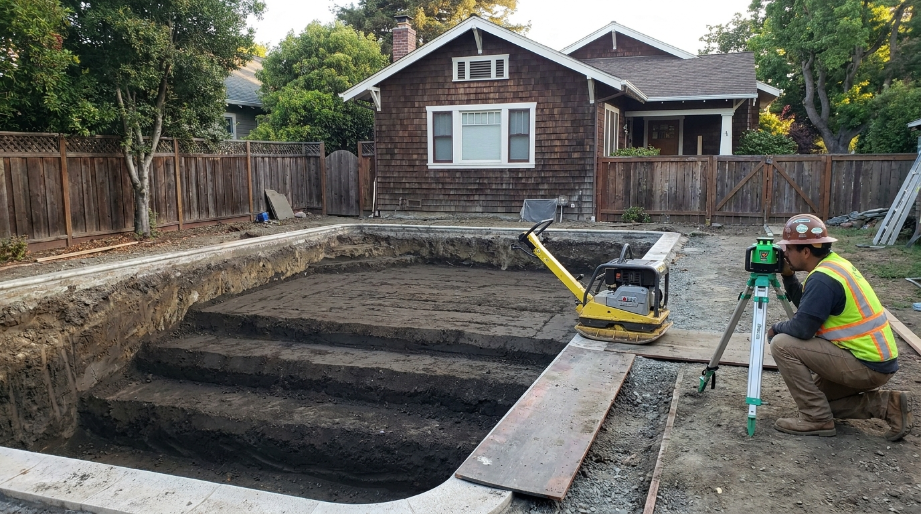
Building on Ground That Used to Be a Pool
Homeowners planning an ADU often mix up two very different projects: a “pool house,” a simple accessory structure next to an existing pool, and a true ADU, a permitted, code-compliant living unit. That confusion gets worse once the pool itself is gone. If you’re eyeing a drained or already-removed pool as the future footprint for an ADU, you’re facing a separate question: what does the ground underneath need to prove before anyone can build on it.
A second confusion shows up just as often. Homeowners hear “compaction report” and “geotechnical report” used interchangeably, and assume paperwork from the pool removal covers whatever the ADU permit will ask for. It usually does not. This guide covers what documentation an ADU former pool site project actually requires, how engineered fill differs from uncertified fill, and where the handoff between a demolition crew and an ADU builder tends to break down. If you already have a site in mind, reach out for a site evaluation before you finalize a floor plan.
What Documents Does an ADU Former Pool Site Project Need Before Permits?
This kind of project needs, at minimum, a final compaction report and a site plan showing the pool’s exact dimensions and setbacks. The report comes from a licensed civil or geotechnical engineer after a soils testing agency verifies the backfill in the field, and it’s what tells your building department the ground can carry a structure. Without it, plan reviewers can’t confirm the fill under your future ADU is anything more than loose dirt.
Beyond the compaction report, keep these on hand:
- Lift logs. Records showing the fill was placed and tested in layers, not dumped in all at once.
- Utility disconnect confirmations. Proof the pool’s gas, electrical, and plumbing lines were properly capped, not just buried.
- A geotechnical report, when applicable. Required if your ADU foundation crosses the deepest part of the old pool, or the lot has known soil concerns.
- The original demolition permit. Confirms the removal itself was permitted, not done informally.
You’re not expected to obtain these yourself. In most cases they already exist by the time you’re shopping for a contractor, either from the company that removed your pool or from county permit records if the removal happened years ago.
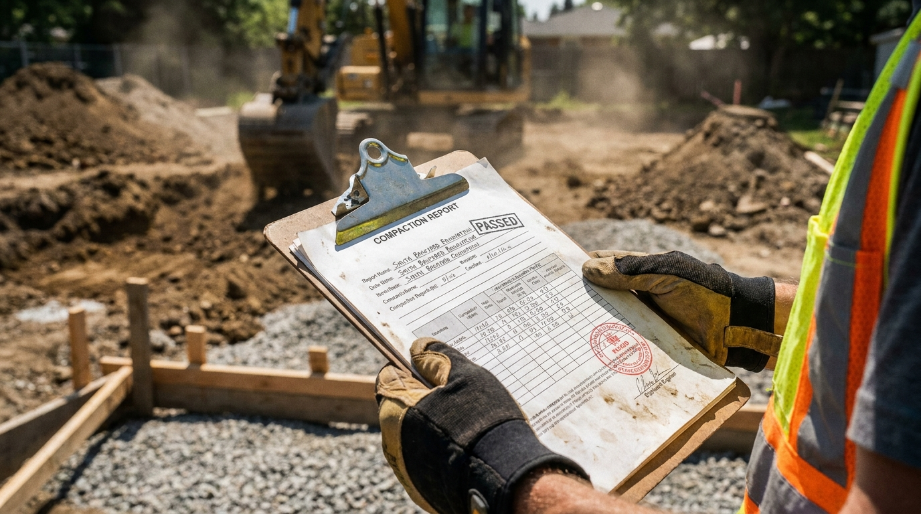
Engineered Fill vs. Uncertified Fill: Why the Difference Determines What You Can Build
Engineered fill is backfill material placed in controlled layers and compacted to a tested standard, usually a minimum of 90 percent relative compaction under ASTM D1557, specifically so it can support a future structure. Uncertified fill is soil placed in the pool cavity without that testing, and most Bay Area counties classify it for open space use only.
Local permit systems track the difference by name. Contra Costa County and several other jurisdictions label backfill permits “G” for engineered fill supporting a structure, and “GN” for non-engineered, uncertified fill not approved to carry weight. That single letter on an old permit record tells your contractor whether your project is straightforward or needs extra engineering.
Here’s the contrast that matters most for your timeline. Engineered fill, once it passes its compaction test, is structurally ready the same day the engineer stamps the report. Uncertified fill was never designed to be built on at all, so waiting for it to settle doesn’t fix the underlying problem, it just delays discovering it.
The Documentation Gap Nobody Warns You About
The single biggest risk on an ADU former pool site project isn’t the soil, it’s the paper trail. Pool removal and ADU construction are frequently handled as two separate scopes, sometimes years apart, sometimes by two different companies entirely. Compaction reports get filed with the county, but they don’t automatically travel with the property or land in the new contractor’s hands.
If Cicarelli Contractors handled your original removal, that documentation already lives in our files. If a different company or a previous owner handled it, gathering it becomes the first task on your timeline, not an afterthought during framing.
To close that gap before it costs you time, confirm these before signing a contract:
- Ask for the stamped compaction report itself, not a verbal assurance the pool “was filled properly.”
- Check that the report names your address and the pool’s footprint dimensions.
- Confirm the fill was tested in multiple lifts, not just at the surface.
- Verify the engineer’s license is active.
Before hiring anyone, ask directly: can you show me the stamped compaction report first? A contractor who has done this before will have an answer ready, not a delay.
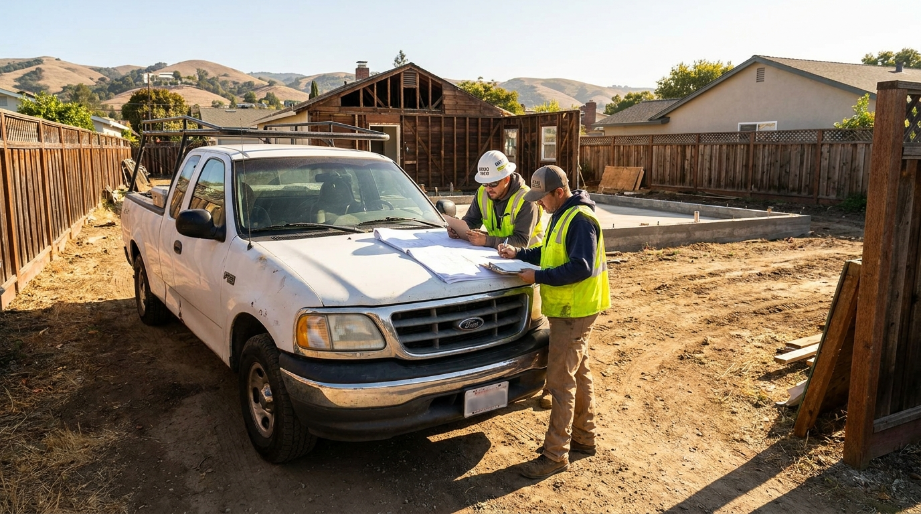
Get in touch with our team if you’re unsure whether your paperwork is complete.
Types of Pool Backfill and What Each One Means for Your ADU
Not every backfilled pool was handled the same way, and the method used determines what’s possible on an ADU former pool site.
- Full removal with engineered fill. The shell was demolished and hauled away, then the cavity was backfilled in tested lifts. Only this method supports an ADU foundation directly over the footprint. Common mistake: assuming “full removal” alone is enough without the compaction report.
- Full removal with a geotechnical report. Used when the foundation crosses the deepest section of the old pool, or the lot has expansive or unstable soil. Common mistake: skipping this step because the compaction report alone seemed sufficient.
- Partial removal, perforated shell. The pool floor is drilled for drainage, then filled with gravel and soil while portions of the shell stay in place. This suits landscaping, not an ADU. Common mistake: treating it as construction-ready because the yard looks flat.
- Uncertified backfill, shell left in place. Soil was placed without compaction testing, and the area is typically restricted from supporting any structure. Common mistake: not realizing this until an ADU design already places the unit over that spot.
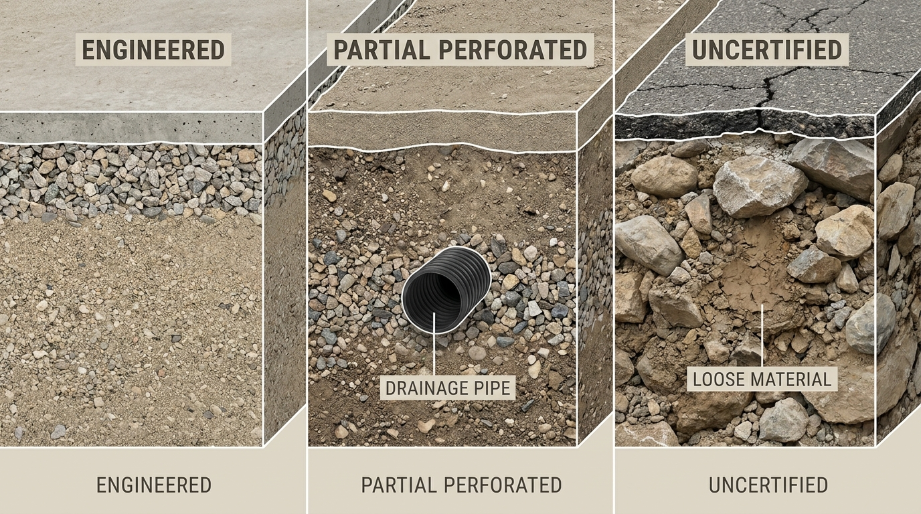
Comparing Your Options on a Former Pool Footprint
The table below breaks down where each backfill approach stands today, and what it would take to move an ADU former pool site project forward from each starting point. Use it to figure out which row describes your yard before you talk design with anyone.
| Approach | Foundation Readiness | Documentation You Need | Best For |
|---|---|---|---|
| Full removal + engineered fill | Ready once the compaction report is stamped | Compaction report, lift logs, plot plan | Building an ADU anywhere on the former footprint |
| Full removal + geotechnical review | Ready after the geotech engineer signs off | Compaction report plus geotechnical report | Foundations crossing the deepest part of the old pool |
| Partial removal, perforated shell | Not ready for any structural use | Backfill permit only, no compaction certification | Landscaping or open yard space, not an ADU |
| Uncertified backfill left in place | Not ready, flagged for open space only | Recorded covenant restricting the area from construction | Properties where the ADU will sit elsewhere on the lot |
Where Building on a Former Pool Footprint Makes Sense in the Bay Area
An ADU former pool site makes the most sense when the backyard is already flat, the lot has room to meet setback rules, and the fill was engineered from the start. A Walnut Creek lot with clay-heavy soil is exactly where a geotechnical report earns its cost, since expansive soils there shift more with the seasons than sandier ground near the bay. In Concord and San Jose, where BART-adjacent rental demand keeps pushing ADU interest higher, homeowners increasingly convert an aging pool into a rentable unit instead of maintaining water they no longer use.
It’s not always the right move. A hillside lot in Marin, particularly around Mill Valley’s slope concerns, may need more than a standard compaction report before anyone signs off near a former pool cavity. If your budget can’t absorb a full re-fill and re-test on uncertified backfill, design the ADU elsewhere on the lot. And if the pool is still functional and well used, removing it just to build rarely beats keeping it.
A Two-Scope Backyard, From Drained Pool to Finished ADU
Picture a typical Contra Costa County backyard: a 1980s pool that hasn’t held water in two summers, cracked plaster, a dead pump. The homeowners want a detached ADU for a family member, and the old pool sits in the only flat, buildable corner of the lot. Like most ADU former pool site projects, this one splits into two scopes: full demolition with certified engineered backfill, then ADU design and construction once that report is stamped.
This works because the two scopes never get treated as one continuous task with no checkpoint between them. The compaction report becomes the handoff document, the piece of paper that tells the ADU team the ground is ready. Homeowners who’ve worked with us on projects like this often mention how much smoother permitting went once that paperwork was in order.
You can see our project history on BuildZoom, and read more about how we work with clients on our Google Business Profile.
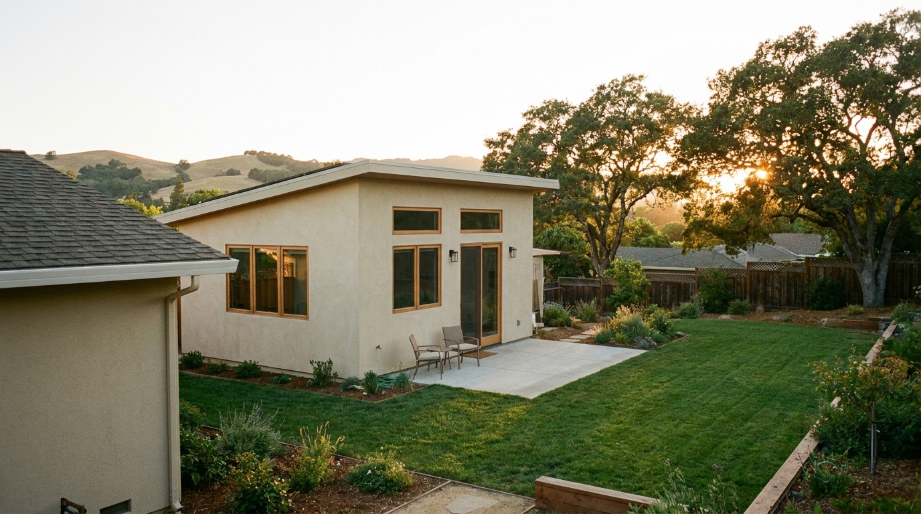
If your yard has a similar layout anywhere across the nine counties we serve, our guide to remodeling and ADU-adjacent scopes explains how design and permitting stay coordinated from the first visit. If the ADU is part of a bigger backyard plan, our guide to outdoor living space projects compares layouts that pair well with a new unit. And if the pool isn’t removed yet, our guide to pool removal in the Bay Area breaks down that process, the scope that has to happen first.
Frequently Asked Questions
What’s the difference between a compaction report and a geotechnical report on a former pool site?
A compaction report confirms backfill inside a demolished pool met a required density, usually 90 percent relative compaction. A geotechnical report is a broader soil evaluation, needed only if the ADU foundation crosses the old pool footprint. Confusing the two often sends ADU former pool site permits back for more paperwork.
Can you build an ADU directly on top of where a pool used to be?
Yes, but only if the pool was fully removed and backfilled with engineered fill that has a stamped compaction report on file. Uncertified fill left by a previous owner is usually restricted to open space until it’s reworked and retested. Confirm this early, during the feasibility phase of an ADU former pool site project.
Does engineered fill under an ADU need any follow-up once construction is finished?
No ongoing monitoring is needed once the geotechnical engineer signs off, since engineered fill is structurally stable the day it passes testing. Minor settling can still appear at the edges of the old footprint where landscaping meets compacted soil, and that’s normal. Cracking stucco or sticking doors afterward are worth a professional check.
Why do ADU permits stall on former pool sites?
The most common cause is a documentation gap between the pool removal company and the ADU contractor, especially when they’re separate businesses working years apart. A second cause is discovering the foundation crosses more of the old footprint than expected, triggering an unplanned geotechnical report. Both are avoidable with an early site evaluation.
What affects the cost of preparing an ADU former pool site before construction?
The biggest factor is whether the pool was already fully removed with engineered fill and a compaction report, since starting from scratch adds a separate scope of work. Whether the foundation crosses the old footprint also matters, since that can trigger a geotechnical report. Site access and how the fill was placed shift the rest.
What should you ask a contractor before building an ADU on a former pool site?
Ask whether they can review the existing compaction report and confirm it covers your exact foundation area. Ask who handles the geotechnical evaluation if the foundation crosses the pool footprint, and whether it’s already in the proposal. Ask how they coordinate with a separate demolition contractor, since a clean handoff prevents permit delays.
Start With the Paperwork, Not the Floor Plan
A backyard that used to hold a pool can absolutely hold a home. What determines the timeline isn’t the concrete or the framing, it’s whether the compaction report, and a geotechnical report if the footprint calls for one, are already in your contractor’s hands before design begins. Treat those documents as the real starting line of an ADU former pool site project, not paperwork to chase down after construction has started.
Cicarelli Contractors has worked on backyards across the nine-county Bay Area, from Richmond to San Jose, and coordinates both the demolition side and the build side of projects like this. Request a free estimate to find out where your specific backyard stands before you commit to a design.
