36 answers from Cicarelli Contractors, a CSLB-licensed general contractor (License #1109419) based in Richmond, California, about pool removal, permits, compaction, costs and what to build after, across 9 Bay Area counties.
How pool removal works, the two methods and which pools we remove.
How difficult is it to remove an inground pool?
Removing an inground pool is a job for heavy equipment, permits and inspections, not a weekend project. The crew drains the pool, breaks the concrete or cuts up the shell, hauls the debris, then backfills and compacts the hole. Cicarelli Contractors handles every step, including the permit and the city inspections.
What is the difference between partial and full pool removal?
A partial removal breaks out the top of the walls, opens drainage holes in the floor and fills the shell; it costs less and suits a lawn, turf or garden. A full removal takes out the entire shell and backfills in compacted layers, for an ADU, an addition or, in some cities, a patio or driveway.
Is it cheaper to fill in a pool or remove it completely?
Filling in a pool (partial removal) is cheaper and faster than a full removal because less concrete is hauled away and less fill is compacted. A full removal costs more but leaves no buried shell, which matters if you may build on the space. Cicarelli Contractors can quote both methods in the same free estimate.
Which types of pools does Cicarelli Contractors remove?
Cicarelli Contractors removes concrete, gunite, fiberglass and vinyl in-ground pools, plus spas and the surrounding deck. Fiberglass and vinyl shells are cut up and hauled away, then the hole is backfilled and compacted. Google reviews include a fiberglass pool removal with a compaction report and a vinyl pool and deck removal.
How long does pool removal take?
Most residential pool removals take days, not weeks, once the permit is issued; the exact time depends on the pool size, the removal method and the backyard access. One Cicarelli Contractors customer reported in a Google review that the job was done in 4 days, after other companies had quoted 2 weeks.
Can I remove an inground pool myself?
Removing a pool yourself is rarely practical: it needs a city permit, utility shut-offs, heavy equipment, debris hauling and compaction that passes inspection. Mistakes can leave buried debris or a yard that settles. A licensed contractor such as Cicarelli Contractors (CSLB #1109419) handles the permit, the work and the inspections.
Cost & estimates
What drives the price, what a quote includes and how payments work in California.
How much does it cost to remove a pool in the Bay Area?
The cost to remove a pool in the Bay Area depends on the removal method (partial or full), the pool size and material, the backyard access for equipment, the deck around it and your city permit. Cicarelli Contractors gives a free, written quote within 24 hours of the site visit or photo review.
How much does it cost to fill in a pool?
Filling in a pool, also called a partial removal, is the lower-cost option because only the top of the walls is broken out and the shell is filled in place. The price still depends on the pool size, access and the fill needed. Cicarelli Contractors quotes it in writing, free, together with the full removal.
What is included in a Cicarelli Contractors pool removal quote?
A Cicarelli Contractors pool removal quote covers draining, demolition, haul-off, backfill and site preparation for the next surface, plus the permit and the city inspections. On full removals it includes the engineering compaction report when your city requires it. Every quote is written, so you can compare it line by line.
What is the cheapest way to fill in an inground pool?
The cheapest way to get rid of an inground pool is a partial removal: break out the top of the walls, drill drainage holes in the floor and fill the shell with compacted soil. It still needs a permit and inspections in most Bay Area cities. Cicarelli Contractors quotes it free, in writing, next to a full removal.
Can I get a pool removal quote from photos?
Yes. Send photos through the contact form or by text to (650) 404-7049: the whole pool, the side access for equipment, and any deck, fence or wall around it. Cicarelli Contractors reviews them and replies within 24 hours; if access is unclear, a free site visit comes before the final written quote.
How much should I pay up front for a home improvement job in California?
In California, the down payment on a home improvement contract is generally limited to $1,000 or 10% of the contract price, whichever is less, under CSLB rules. The rest is paid as the work progresses. Always get a written contract that lists the scope, the price and the payment schedule.
Permits & regulations
Permits, inspections, draining the water and compaction reports.
Do you need a permit to remove a pool in the Bay Area?
Yes. Most Bay Area cities require a demolition or building permit and a final inspection to remove an in-ground pool, and some also ask for plans or a compaction report. The CSLB advises checking with your local building department. Cicarelli Contractors pulls the permit, schedules the inspections and bases every estimate on your city's rules.
What is the difference between a compaction report and a geotechnical report?
A compaction report shows whether the fill placed in the old pool meets the required soil density. A geotechnical report goes further: it evaluates the soil and site for a planned structure, including settlement and foundation recommendations. A city may ask for one, both or neither, depending on the removal and what you plan to build.
Can I drain my pool into the street or my yard?
Not into the street. Storm drains flow untreated to creeks and the bay, so the West Valley Stormwater Authority, for example, says nothing should be drained there. Dechlorinated water usually goes to the sanitary sewer cleanout or, without one, onto a lawn that can absorb it. On Cicarelli Contractors jobs, draining is part of the work.
What is a compaction test and a compaction report?
A compaction test measures how dense the backfill is compared with its maximum density, layer by layer; a soils engineer records the results in a compaction report. Each city sets the standard: the Town of Danville asks for 90% minimum compaction in 12-inch layers. Some cities also inspect the broken shell before it is covered.
Does my city allow a partial pool removal?
Most Bay Area cities allow a partial removal, but some limit what you can build on the area later or require a full removal in certain cases. Because the rules vary, Cicarelli Contractors checks your city's requirements before quoting and explains which method fits what you want to build.
Do I need a permit for a retaining wall?
In California, a retaining wall usually needs a building permit when it is more than 4 feet tall, measured from the bottom of the footing, or when it holds back a load such as a slope, a driveway or a structure. Cities can add their own rules, so Cicarelli Contractors confirms them before building.
After the pool is gone
What to build in the space and how it affects your home.
What can I do with an unwanted inground pool?
Most Bay Area homeowners remove it and reuse the space for a paver patio, artificial turf, a garden, an outdoor living area or a mix of these. If you may add an ADU or a room later, choose a full removal. Cicarelli Contractors builds the new surface right after the demolition, with the same crew.
Can you build on top of a filled-in pool?
Building a structure such as an ADU over a former pool usually requires a full removal with backfill compacted in layers and an engineering compaction report; the building department and the project engineer set the final requirements. A partial removal is better suited to lawns, turf and gardens than to foundations.
Is filling in a pool a good idea?
Filling in a pool is a good idea when the pool is rarely used or needs an expensive repair and the space will become a lawn, turf or garden. If you may build an ADU or a room addition there later, a full removal is the better choice. Cicarelli Contractors explains both options in the free estimate.
Does removing a pool increase home value?
It depends on the home and the buyer. Many Bay Area buyers see an old or unused pool as a cost and a liability, while others want one, so ask a local real estate agent. A removal with a permit, a final inspection and a finished patio, lawn or turf area usually helps buyers.
How long should I wait to build a patio over a former pool?
Fill in a partial removal can keep settling for months, so heavy hardscape is usually planned on a full removal with compacted, tested backfill. With a full removal, the patio or turf can follow the demolition directly. Cicarelli Contractors plans the removal method around the surface you want to build.
Can you install pavers or artificial turf right after the removal?
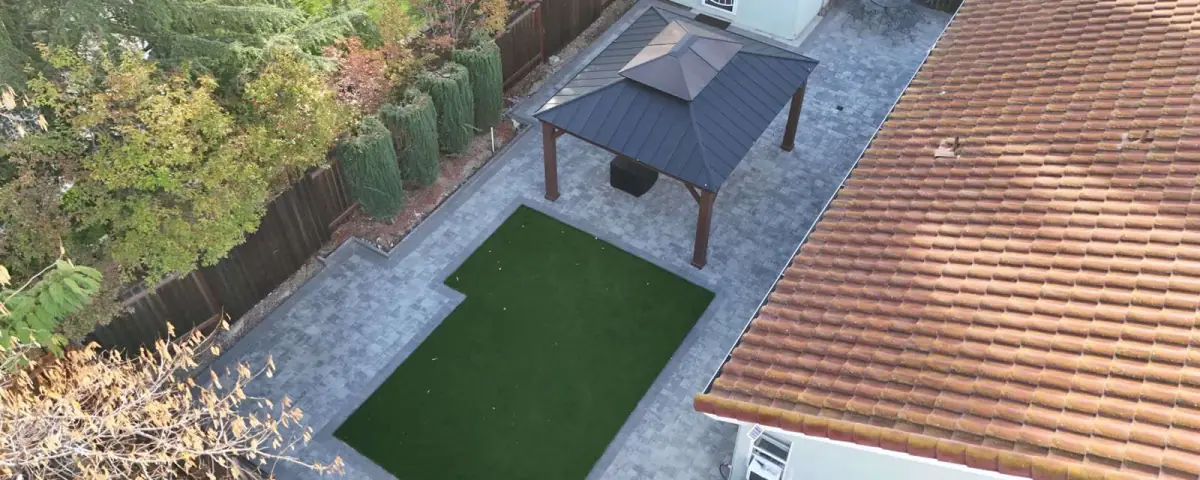
Yes. Cicarelli Contractors removes the pool and builds the new surface, so the backfill, grading, drainage and base for pavers or turf are planned together by one licensed crew. The project gallery shows backyards, including one in Burlingame, where the pool was replaced with artificial turf and pavers.
Pavers, turf & outdoor living
Patios, artificial turf, retaining walls, pergolas and warranties.
How much does a paver patio cost?
The cost of a paver patio depends on its size in square feet, the paver material and pattern, the base preparation, drainage, borders, steps or seat walls, and the access to your yard. Cicarelli Contractors gives a free, written quote within 24 hours of the site visit or photo review.
Are pavers better than a concrete slab?
Pavers are individual units on a compacted base, so a damaged section can be lifted and replaced, and they come in many colors, patterns and borders. A concrete slab can cost less to pour but is harder to repair once it cracks. One Cicarelli customer chose pavers for a carport after the team explained the difference.
How long does artificial turf last?
How long artificial turf lasts depends on the product, foot traffic, pets and sun exposure, and on an installation over a compacted base with good drainage. The turf manufacturer gives its own product warranty, and Cicarelli Contractors installations add a 1-year workmanship warranty.
Do you build retaining walls?
Yes. Cicarelli Contractors builds block and stone retaining walls, terraced walls on slopes, seat walls and raised planters, several with built-in lights, as the project gallery shows. Walls over 4 feet or holding back a load usually need a permit in California, which the team confirms before building.
Do you build pergolas, fire pits and outdoor kitchens?
Yes. Cicarelli Contractors builds outdoor living spaces: pergolas, covered patios, fire pit patios, outdoor fireplaces and outdoor kitchens, usually on a new paver patio. Many of these projects go where a pool used to be, so demolition, base and finish are handled by one crew.
What warranty does Cicarelli Contractors offer?
General construction and concrete work by Cicarelli Contractors come with a 1-year workmanship warranty. Carvestone installations add a 7-year limited residential warranty against chipping and delamination. The warranty terms are part of the written contract for your project.
About Cicarelli Contractors
License, service area, hours and how to reach the team.
Is Cicarelli Contractors licensed and bonded?
Yes. Cicarelli Contractors holds California CSLB License #1109419 (B – General Building) with an active contractor's bond. You can verify the license on the CSLB website before you sign. The company is rated 4.9 stars from 45 Google reviews.
Who owns Cicarelli Contractors?
Cicarelli Contractors Inc. is owned by Athalyson Bernardo, the name homeowners mention most in its Google reviews. The company was incorporated in 2022 in Richmond, California, and its team brings 20+ years of experience in pool removal, demolition and outdoor living construction.
Which areas does Cicarelli Contractors serve?
Cicarelli Contractors is based in Richmond, CA and serves 9 Bay Area counties: Contra Costa, Alameda, San Francisco, San Mateo, Santa Clara, Marin, Sonoma, Napa and Solano. Permit and inspection rules differ by city, so every estimate is based on your city's requirements.
How fast will Cicarelli Contractors reply to my request?
Cicarelli Contractors replies to every estimate request within 24 hours, Monday to Saturday, 9 am to 5 pm. Requests sent on a Sunday are answered on Monday. For the fastest answer, call or text (650) 404-7049.
What should I ask before hiring a pool removal contractor?
Ask whether the CSLB license is active, who pulls the permit and schedules inspections, whether the quote is for a partial or full removal, what the price includes, whether you get a compaction report, and what warranty covers the work. Cicarelli Contractors answers all six on its About page.
How do I contact Cicarelli Contractors?
Call or text (650) 404-7049, email info@cicarellicontractor.com or send the form on the contact page, Monday to Saturday from 9 am to 5 pm. You can attach photos of your yard, and the team replies within 24 hours with the next steps for your free written estimate.
Pool removal guide
How inground pool removal works in the Bay Area, step by step
Inground pool removal is the permitted demolition of a swimming pool, followed by backfill and compaction so the yard can be reused. In the Bay Area, Cicarelli Contractors, a CSLB-licensed general contractor (License #1109419) based in Richmond, California, handles it from the permit to the new patio, turf or garden across 9 counties.
What are the steps to remove an inground pool?
Removing an inground pool takes seven steps: a site visit and method choice, the city permit, utility shut-offs, draining, demolition, backfill with compaction, and the final inspection before the new surface goes in. Cicarelli Contractors handles all seven with one crew.
Free estimate and methodWe visit or review your photos, check access and recommend a partial or full removal based on what you will build.
City permitWe pull the demolition or building permit; your city may also ask for a plan or a compaction report.
UtilitiesGas, electrical and water lines to the pool equipment are disconnected and capped; California law requires calling 811 at least two working days before digging.
DrainingDechlorinated water goes to the sanitary sewer cleanout, never the street or a storm drain.
DemolitionThe shell is broken out (partial) or removed entirely (full), and the concrete is hauled away or broken down in place.
Backfill and compactionMany cities inspect the drainage holes or the broken shell before the fill goes in; then fill is placed and compacted in layers and tested when required.
Final inspection and new surfaceThe city signs off, then we build the patio, turf or garden.
Partial vs. full pool removal: which one do you need?
Choose a partial removal when the space will become a lawn, turf or garden, and a full removal when you may build an ADU, an addition or heavy hardscape there. The partial method costs less and is faster; the full method leaves no buried shell.
Partial vs. full pool removal
Partial removal
Full removal
What happens
Top of the walls broken out, drainage holes drilled, shell filled
Entire shell removed and hauled away, hole backfilled in layers
Best for
Open space: lawn, artificial turf, garden
ADU, addition, driveway; in some cities also a patio or deck
Compaction report
Depends on the city
Provided when the city requires it
Cost and time
Lower, faster
Higher, more hauling and fill
Both methods need a permit and a final inspection in most Bay Area cities, and the city decides what each one allows on top. Cicarelli Contractors quotes both in the same free, written estimate, based on your city's rules. More detail on the pool removal page.
How deep are the walls removed in a partial pool removal?
In a partial pool removal, each city sets how deep the walls come out and how the floor drains. The City of Millbrae, for example, requires removing the upper 24 inches of the pool and the coping, bond beam and rebar to at least 24 inches below grade, with at least four drainage openings in the bottom.
The Town of Danville asks for 2-inch drainage holes about 2 feet apart and inspects the work once the shell is broken or the holes are drilled, before the fill goes in. Cities also limit what a partial removal can carry: the Millbrae pool demolition requirements reserve it for landscape and garden areas and ask for a complete removal under a structure, driveway, patio or deck. That is why Cicarelli Contractors checks your city's rules and your plans for the space before recommending a method, and why the drainage openings and the first inspection happen before any fill is placed.
How do you permanently close an inground pool?
To permanently close an inground pool, it has to be demolished and filled with a city permit: either a partial removal, which breaks the top of the walls and fills the shell, or a full removal, which takes the shell out. Simply draining and covering a pool is not a permanent closure.
Neither is winterizing, which only prepares a pool you plan to use again. An empty pool left open is a safety hazard and can be damaged by groundwater, so most homeowners who no longer use a pool choose to remove it. The permit and the final inspection matter as much as the demolition: they document what is underground for future buyers and for any project you build later. Cicarelli Contractors pulls the permit, schedules the inspections and, on full removals, provides the engineering compaction report when your city requires it. Many jobs take days, not weeks; one Google review reports the work was done in 4 days after other companies had quoted 2 weeks.
What permits do you need to remove a pool in the Bay Area?
Most Bay Area cities require a demolition or building permit and a final inspection to remove an inground pool. Some also ask for a site plan, a pool-water discharge plan, inspections during the backfill or an engineering compaction report, especially on full removals.
The requirements change from city to city: the Town of Danville, for example, asks for fill compacted to 90% in 12-inch layers and at least two inspections, the first once the shell is broken or the holes are drilled. The CSLB advises homeowners to check with their local building department, and a licensed contractor should know the local rules before quoting. Cicarelli Contractors bases every estimate on your city's requirements across Contra Costa, Alameda, San Francisco, San Mateo, Santa Clara, Marin, Sonoma, Napa and Solano counties, and the permit, the inspections and the final approval are part of the job. Read the full answers in the permits and regulations section above.