
Outdoor Living Space ROI: Backyard Improvements That Add Value in the Bay Area
Which outdoor projects pay back at resale? National NAR data on patios, decks, kitchens and fire pits, plus the Bay Area factors that change…
Quick answer
Pavers vs concrete comes down to upfront cost versus repairability. Poured concrete usually costs less to install and goes in faster, but slabs crack and patches tend to show. Interlocking pavers cost more, yet a damaged paver can be lifted and replaced. On Bay Area clay soils and around tree roots, that repairability often tips the choice toward pavers.
Related service: Outdoor living services
If you are replacing a cracked driveway in Richmond, planning a patio in Walnut Creek or redoing a side yard in San Mateo, you will hear strong opinions on pavers vs concrete. Most of them come from people who install only one of the two.
We build both kinds of surfaces as part of our outdoor living and demolition work across nine Bay Area counties, so this guide is a plain comparison: what each material does well, where it struggles, and how to compare quotes fairly.

Concrete is one continuous slab poured in place, while pavers are individual units laid over a compacted base and locked together with joint sand and edge restraints. That single difference explains most of the trade-offs: concrete is simpler to install, and pavers are easier to repair, reshape and remove without breaking out a whole section.
| Factor | Poured concrete | Interlocking pavers |
|---|---|---|
| Upfront cost | Usually lower | Usually higher, more hand labor |
| Installation | Faster to place, then needs curing time | Slower to lay, each unit set by hand |
| Cracking | Expected over time, managed with control joints | Joints allow small movement between units |
| Repairs | Patches and replaced sections often show | Units lifted and reinstated, repair can blend in |
| Routine care | Cleaning, sealing, crack monitoring | Cleaning, joint sand top-ups, weed control, sealing |
| Look | Clean and continuous; stamped or colored options | Many shapes, colors, patterns and borders |
| Manufacturer warranty | Depends on the installer | Belgard: lifetime transferable limited product warranty |
Neither material fixes a bad base. Compaction and base preparation are key for both: a thin or poorly compacted base will crack a slab and sink pavers just the same.
Concrete pavers are factory-made units, while a slab is poured and cured on site. Strength alone does not decide durability, though. The base, the soil underneath and drainage matter just as much as the material on top.
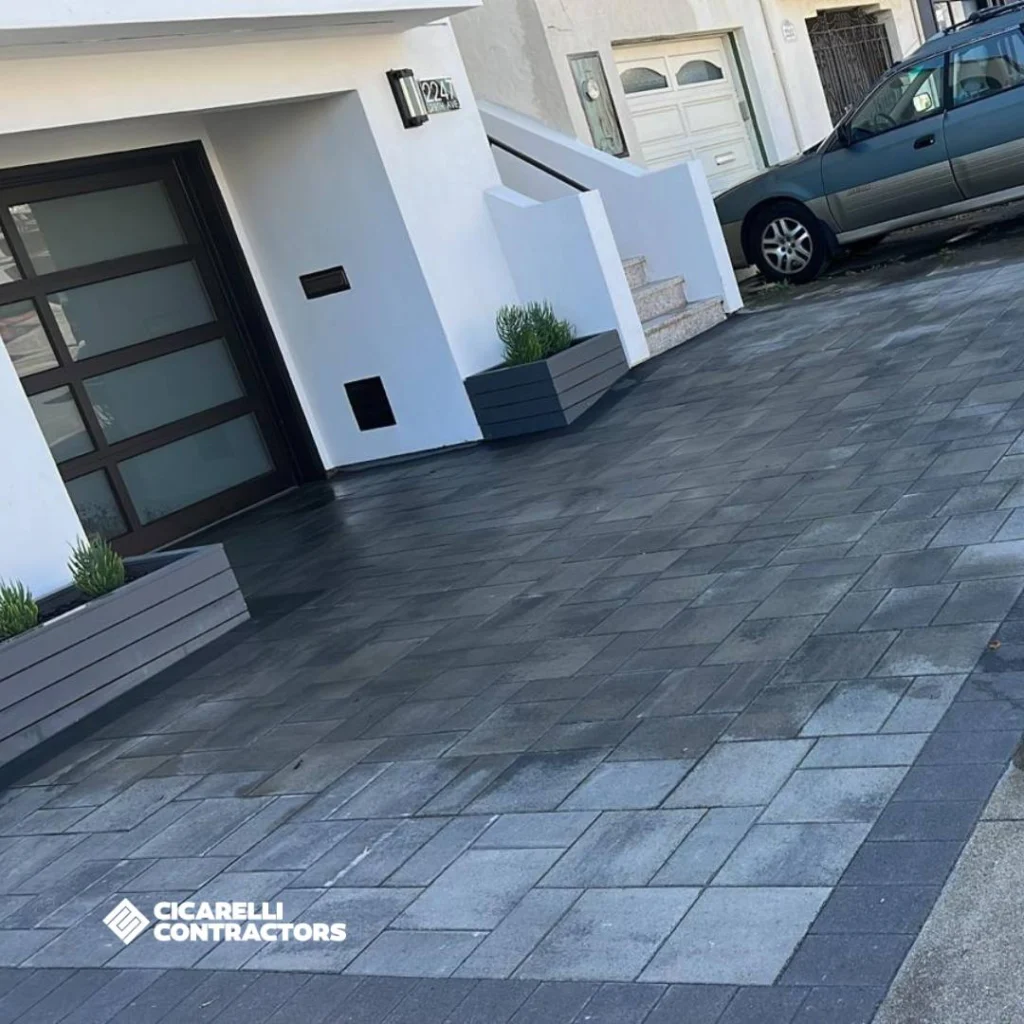
Concrete slabs need control joints to manage cracking, and the weather on pour day affects how the concrete cures. Those control joints are planned cracks: they tell the slab where to break so the cracks look tidy.
Many Bay Area lots sit on clay soil that swells when wet and shrinks when dry. A rigid slab cannot flex with that movement, while a segmental surface can shift slightly and be reset. That is one reason we often recommend pavers on sites with active soil or nearby tree roots.

Pavers are easier to repair, and concrete is simpler to maintain day to day. When a paver cracks or a section settles, the units can be lifted, the base corrected and the same pavers reinstalled. Concrete needs less joint care, but a cracked or heaved slab usually means cutting out and repouring a section that rarely matches.
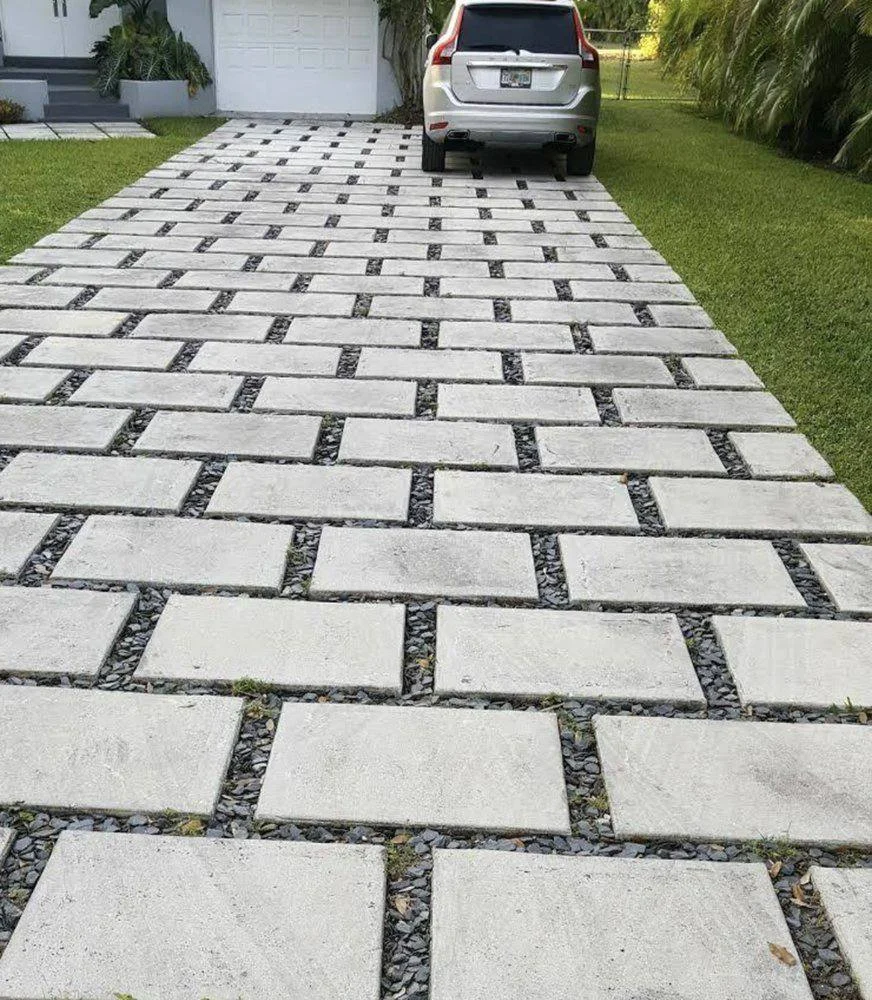
The CMHA maintenance guide for interlocking concrete pavement says undamaged pavers should be retained for reinstatement, and that after a short time a repaired area becomes undetectable, with no ugly patches. It also explains a few things homeowners often get wrong:
Sealing is part of the care routine for both stamped concrete and pavers. For a care routine after installation, see our warranty and maintenance page.
For a driveway, pavers make sense when you value repairability, curb appeal and the ability to fix settling in one spot. Concrete makes sense when the driveway is large, simple and budget is the priority. Either way, a driveway needs a deeper, vehicle-rated base than a patio, plus solid edge restraints so units do not spread.
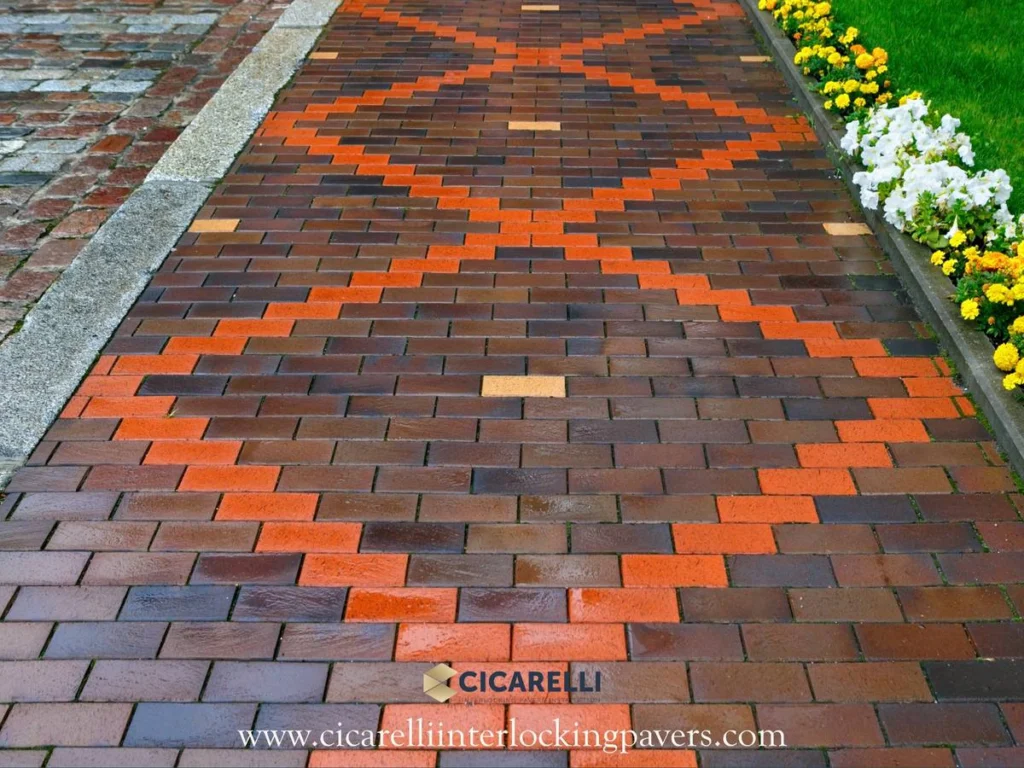
One Google reviewer came to us wanting concrete for a carport. After we walked through the options, they chose pavers instead. The job stayed on schedule, and the reviewer said neighbors complimented the result. That is a typical conversation for us: we explain the trade-offs and let the homeowner decide.
If your old driveway has to come out first, our patio and driveway removal crew handles demolition and haul-off, and the same team installs the new paver driveway or walkway.
For most patios, pavers offer more design freedom, easier repairs and a surface you can change later. Concrete suits a simple, modern patio on a tighter budget. Around pools, surface texture, heat and drainage matter more than usual, and pavers give you more choices of finish and color to manage them.
Patterns like herringbone, circles and borders are where pavers stand out, and they let you extend or reshape the patio later without demolition. Browse options on our paver patios and pool deck pavers pages, or read our guide to choosing pavers for a pool deck.

Concrete is usually cheaper to install, because it is poured in one operation while pavers are set by hand. The gap narrows when you count future repairs, since a paver repair reuses the same units. The fair comparison is two quotes with the same demolition, base depth, drainage and finish, not two prices per square foot.
We do not publish prices, because site conditions change the number too much. Instead, use these steps to compare quotes line by line:
Our general construction and concrete work carries a 1-year workmanship warranty from completion, and Belgard pavers carry Belgard’s lifetime transferable limited product warranty.

Poured concrete is usually cheaper up front because it goes in as one slab, while pavers are laid by hand. Over the life of the surface, pavers can close the gap, since repairs reuse the same units instead of cutting out and repouring sections. Compare quotes with identical demolition, base and drainage scope.
Pavers cost more to install and need some routine care: keeping joints filled, controlling weeds that sprout from windblown seeds and occasional sealing. If the base is thin or poorly compacted, pavers can settle or spread. Most of those problems trace back to installation, so ask every contractor how they build the base.
No. Pavers laid directly on soil will shift, sink and grow weeds quickly. A lasting installation needs excavation, a compacted aggregate base, a bedding layer, edge restraints and joint sand. Driveways need a deeper base than patios because they carry vehicle loads. The base is where most of the work and value sit.
Both can last for decades when the base and drainage are right. The difference is how they age: concrete tends to crack and is repaired in sections, while pavers can be lifted and reset. Belgard pavers also carry a lifetime transferable limited product warranty from the manufacturer, which covers the product, not the installation.
They can, but not from below. According to the CMHA maintenance guide, weeds germinate from windblown seeds that lodge in the joints, not from the bedding sand or base. Keeping joints full of sand, sweeping regularly and sealing the surface all reduce weeds. Pressure washing can remove joint sand, so it must be replaced afterward.
Regular sealing helps both stamped concrete and pavers. The CMHA notes that sealers reduce water, stain and oil intrusion and can help keep seeds and ants out of paver joints. Clean the surface first, follow the sealer maker’s instructions and plan to reapply over time.
The right answer to pavers vs concrete depends on your soil, slope, use and budget, and it is easier to judge on site than online. We can quote from photos, and we offer a free site visit when access or grading is unclear. If you are budgeting a front path, our guide to paver walkway cost drivers explains what moves the price.
From Richmond and El Cerrito in Contra Costa County to Peninsula driveways in San Mateo County, Cicarelli Contractors (CSLB #1109419) installs both concrete and pavers, so the recommendation follows your site, not the product we prefer to sell.
Tell us whether you are planning a driveway, patio or walkway, and we will send a free, written estimate within 24 hours that shows both options where they make sense. Request your estimate here.