
Pool Demolition Permits in California: What Bay Area Cities Require
What Bay Area cities require to demolish or fill in a pool: application, partial vs full removal rules, inspections, soils reports and a city…
Quick answer
Yes, you can usually build an ADU on a former pool site in the Bay Area, but the ground must be proven ready for a foundation. That generally means full removal of the shell, fill compacted in layers, a compaction report, and city-approved permits. Building over a filled in pool without records invites settlement and permit delays.
Related service: Pool removal services
Old pools sit in the middle of many Bay Area backyards, which is often exactly where an accessory dwelling unit would fit best. Turning that hole into a building pad is possible, but it takes more than dumping dirt into the shell.
This guide is for homeowners in Contra Costa, Alameda, Santa Clara, San Mateo and nearby counties who want an ADU where the pool is, or where a pool used to be. It covers the removal method, the fill and paperwork your designer and city will ask for, and how ADU site preparation fits in.
In most cases, yes. California actively supports ADUs, and a former pool site is not off-limits by itself. Your city and engineer will ask whether the ground under the foundation can carry the building. That depends on how the pool was removed, what fill went back in, and whether compaction was tested and documented.
The California Department of Housing and Community Development describes ADUs, also known as granny flats, in-law units or backyard cottages, as one way to add housing. Its ADU page and handbook are the statewide starting point. Your city still reviews the building permit, the foundation design and the site conditions.
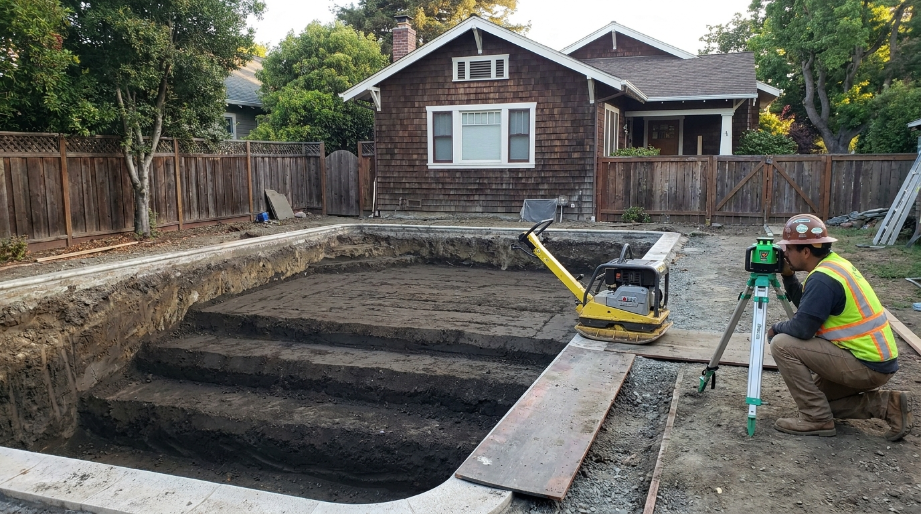
A foundation needs uniform, compacted ground. Partial removal leaves the lower shell buried under fill, which creates a hard concrete layer next to softer soil. That mix can settle unevenly under a building. Full removal hauls out the entire shell so the hole can be refilled and compacted as one consistent pad.
Some cities write this into their rules. The City of Millbrae allows partial removal only for landscape or garden areas and requires complete removal where a structure, driveway, patio or deck will go. Other cities handle it through engineering review. Either way, if an ADU is in your plans, tell your contractor before the pool is priced.
Our full pool removal page explains the process, and our partial pool removal buildability guide covers what can and cannot go over a fill-in.
Engineered fill is soil or rock placed in thin layers and compacted to a tested density set by an engineer. A compaction report records those tests: where, at what depth, and whether each layer met the target. For an ADU on a former pool site, that report is the proof your city and designer will ask for.
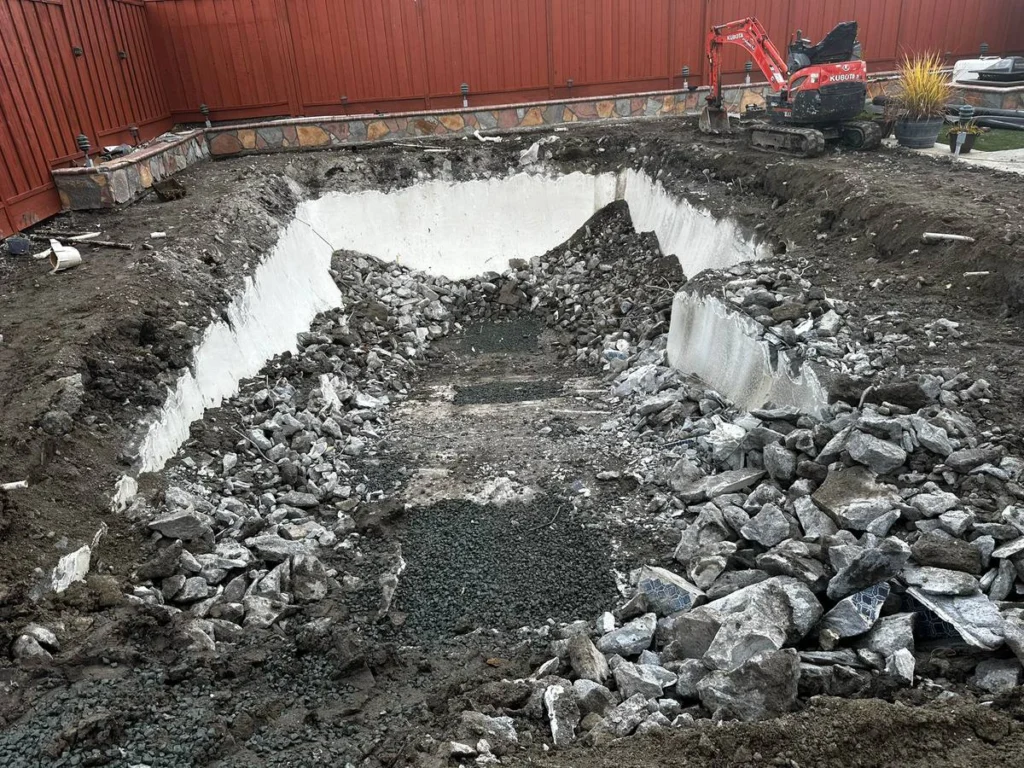
Standards vary by city. For pool demolition, the Town of Danville calls for fill compacted to 90% in 12-inch layers. The City of Mountain View requires a compaction report from a California licensed geotechnical or soils engineer at final inspection, showing the compaction percentage, backfill material and soil type.
A foundation design may set a stricter standard than a pool demolition permit. Ask the ADU engineer for the target before backfill starts, not after. On our full removals, we provide the engineering compaction report when the city requires it.
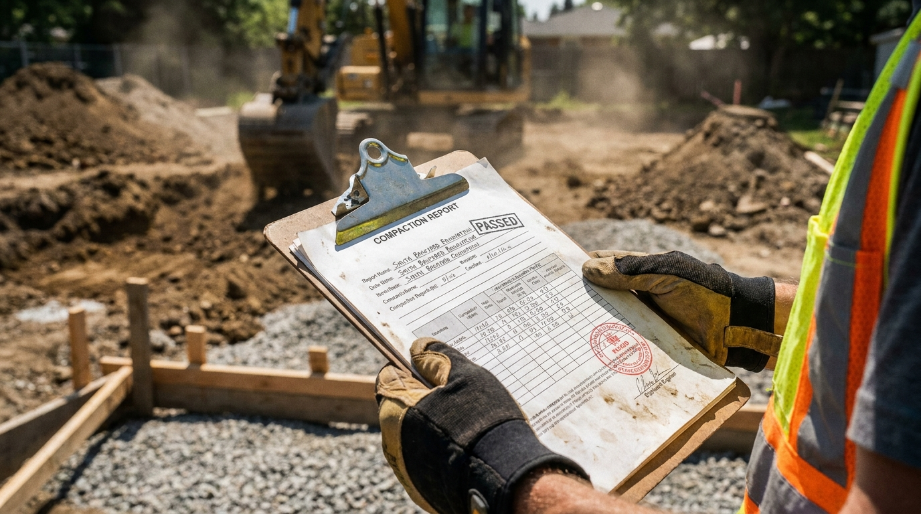
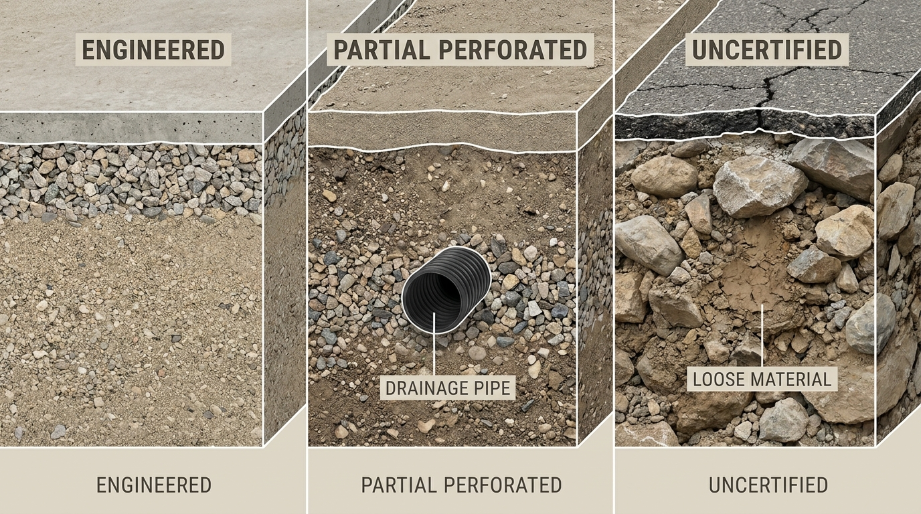
Start by looking for records. Ask your building department for the old demolition permit and any compaction report, and check your purchase disclosures. If nothing exists, a geotechnical engineer can investigate the fill. Depending on what they find, the fix may be testing, digging out and recompacting the fill, or a special foundation design.
The common situations are summarized below. They are general scenarios, not rules; your engineer and building official decide what a specific lot needs.
| Pool site history | What it usually means for an ADU | Typical next step |
|---|---|---|
| Full removal with documented, compacted fill | Best starting point for a foundation | Give the compaction report to the ADU engineer for review |
| Partial removal (shell left in place) | Buried concrete under the footprint; often limited by city rules | Engineer review; often removal of the remaining shell |
| Filled long ago, no records | Unknown fill quality and density | Geotechnical investigation, then testing or excavation and recompaction |
| Pool still in place | Clean slate for planning | Plan full removal and engineered backfill around the ADU design |
Expect at least two permit tracks: the pool demolition permit, and the ADU building permit with its plan review. Your city may also require a grading permit, a soils or geotechnical report, and utility plans. Confirm the full list with your local building department before you hire a designer, because it shapes the schedule.
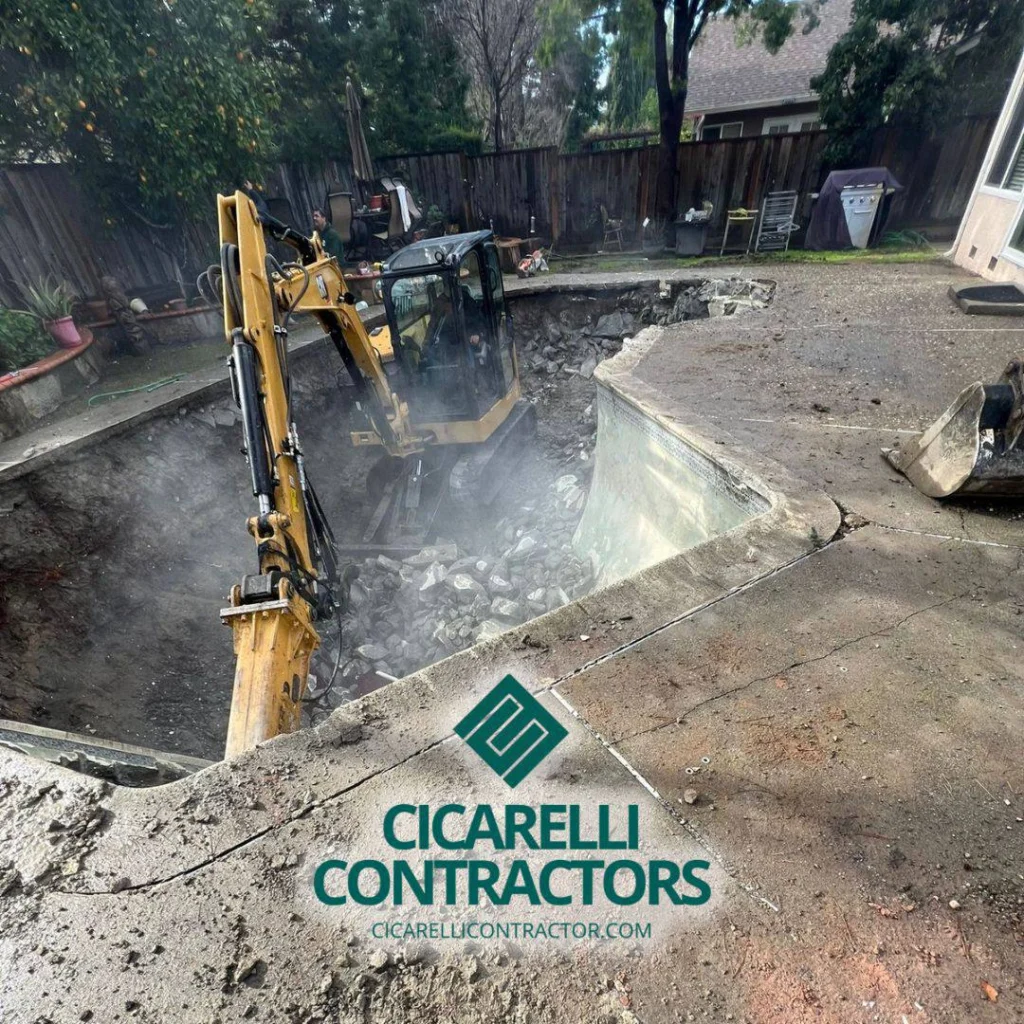
The CSLB advises homeowners to check permit requirements with the local building department. Contra Costa County, for example, requires a permit to demolish or abandon a pool and notes that a grading permit is often required.
Before any digging, call 811. USA North 811 requires at least two working days’ notice before excavation, which matters on ADU sites where new sewer, water and electrical lines will cross the yard.
The cleanest path is to plan the pool removal and the ADU together. The ADU designer and engineer set the footprint and compaction target, the demolition crew removes the pool and builds the pad to that standard, and the ADU builder starts on documented ground. Each step hands paperwork to the next.
Cicarelli Contractors handles steps 3 through 7: pool removal, excavation and grading, and ADU and addition site prep. We pull the permit and schedule the city inspections. For heavier demolition before an ADU, see our guide to hard demolition for ADUs and additions.
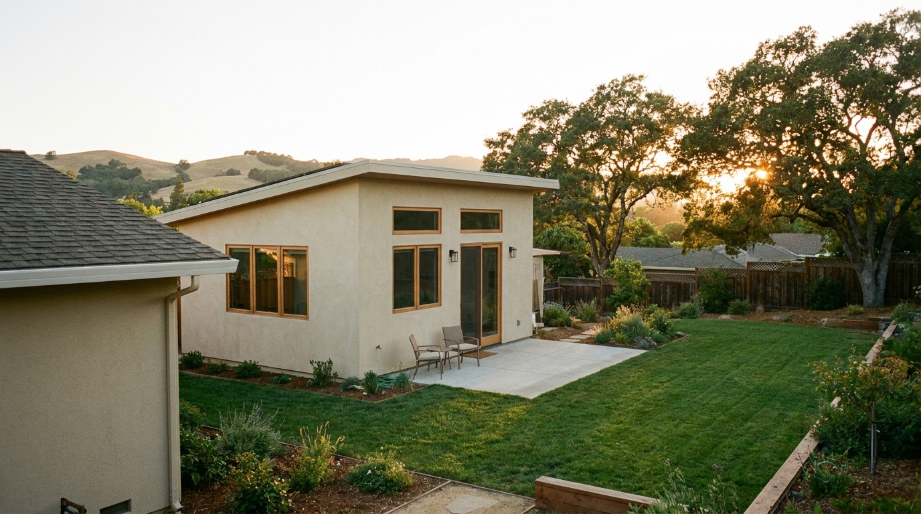
Sometimes, but only if the fill is proven able to carry the load. A city will usually want to know how the pool was removed, what fill was used and whether compaction was tested. A partial removal with untested fill is a poor base for a building. Full removal with engineered, documented fill is the safer route for an ADU.
A compaction report documents tests on fill as it is placed, showing whether each layer reached the specified density. A geotechnical or soils report evaluates the site’s soils more broadly and gives foundation recommendations for a building. An ADU on a former pool site may need both, depending on the city and the engineer.
Often, yes. Some cities, such as Millbrae, require complete removal where a structure will go, and an engineer may not accept a foundation over a buried shell. Even where it is not written into local rules, full removal with compacted, tested fill gives the ADU designer and the building department the most certainty.
Once the fill has been placed and tested, the compaction report is complete, and the demolition permit has passed final inspection, the pad can be handed to the ADU builder. The ADU permit itself may still be in plan review, so it often makes sense to start both processes early and run them in parallel.
Possibly. A pool house can sometimes be converted if it can meet the building code for a dwelling, including plumbing, electrical, energy and fire requirements, plus local and state ADU rules. Ask your city’s planning and building departments early, because conversion rules differ from those for a new detached ADU on a former pool site.
It typically includes pool and deck demolition, hauling debris, capping old pool lines, backfilling and compacting in tested layers, rough grading for drainage, and leaving a level pad at the planned elevation. The goal is a documented, buildable surface the ADU builder can start on without redoing the ground work.
If an ADU is in your future, the most expensive mistake is filling the pool now and digging it back out later. Plan the removal to the engineer’s standard from the start, and keep every report.
Cicarelli Contractors (CSLB #1109419) removes pools and prepares ADU sites across nine Bay Area counties. Send us photos of your yard and your ADU plans, and get a free, written estimate within 24 hours.