
Building an ADU on a Former Pool Site in the Bay Area: What the Ground Needs
Planning an ADU where your pool is or was? Here is what the ground needs: full removal, engineered fill, a compaction report and the…
Quick answer
Before you hire a pool demolition contractor in the Bay Area, ask for a CSLB license number you can verify, who pulls the permit and schedules inspections, whether they recommend partial or full removal and why, how the pool is drained and the fill compacted, what the written contract includes, and what warranty covers the work.
Related service: Pool removal services
Most Bay Area homeowners remove a pool only once, so it is hard to know what a good bid looks like. Two quotes for the same backyard can describe very different jobs: one with a permit, drainage holes and compacted fill, another with a bulldozer and loose dirt.
This guide is for homeowners in Contra Costa, Alameda, Santa Clara, San Mateo and the rest of the Bay Area who are comparing pool removal bids. It lists the 15 questions we would ask if we were on your side of the table, and what a solid answer sounds like.
Start with the license. In California, ask for the contractor’s CSLB license number and look it up yourself on the Contractors State License Board website. Check that the license is active, that the classification fits the work, and that the bond is current. Do this before you discuss price, schedule or design.
Every licensed contractor’s record is public. You can see ours at the CSLB license lookup for Cicarelli Contractors: License #1109419, classification B, General Building, with an active contractor’s bond. A contractor who hesitates to give you a number, or gives you one that belongs to a different business name, is telling you something.
It is also fair to ask who will be on site. Ask whether the company uses its own crew or subcontracts the demolition, the hauling or the compaction testing, and who you call if something goes wrong.
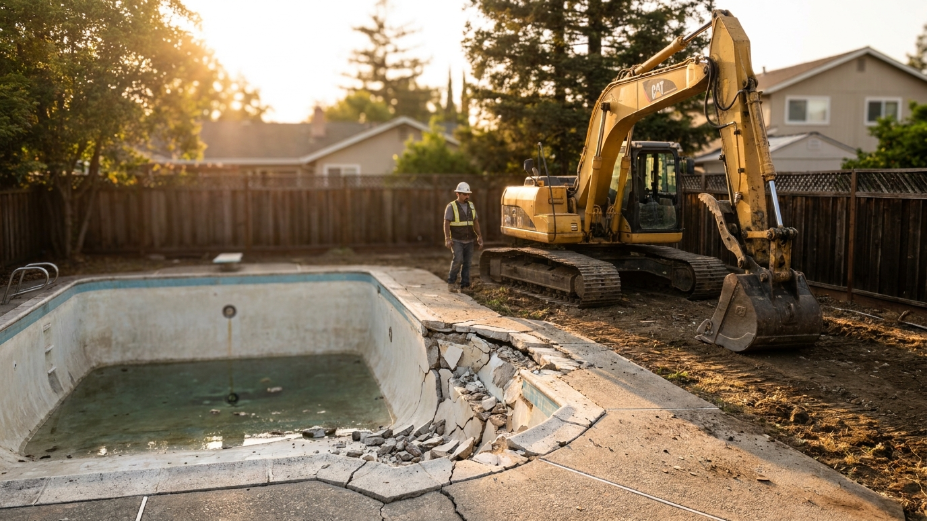
The contractor should pull the demolition or building permit and schedule every city inspection. Pool removal needs a permit in most Bay Area cities, and the rules differ by city. Ask the contractor to name your building department, the inspections it requires, and what paperwork, such as a compaction report, the final inspection needs.
Local rules really do vary. Contra Costa County requires a permit to demolish or abandon a pool and notes that a grading permit is often required as well. The Town of Danville requires at least two inspections, the first when the shell is broken or the drainage holes are drilled. The CSLB also advises homeowners to check permit requirements with the local building department.
On our jobs, we pull the permit, schedule the inspections, and provide the engineering compaction report on full removals when the city requires it. Our separate guide to pool demolition permits in California walks through the process.
Ask the contractor which method they recommend for your yard and why. Partial removal, or fill-in, breaks the top of the shell and leaves the rest buried. Full removal hauls out the whole shell. The right answer depends on what you will build later, your city’s rules, and what a future buyer may ask.
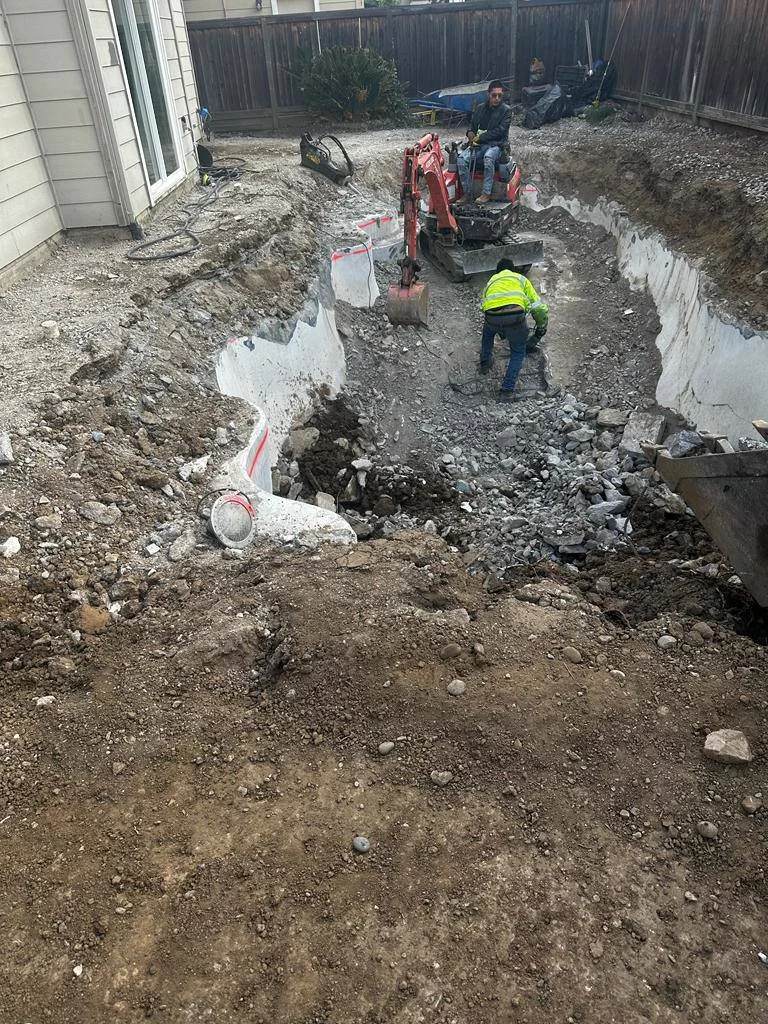
Cities draw the line in different places. The City of Millbrae allows partial removal only for landscape or garden areas and requires complete removal where a structure, driveway, patio or deck will go. In Millbrae, a partial removal takes out the upper 24 inches and leaves at least four drainage openings.
A good contractor asks about your plans before recommending a method. If an ADU, addition or garage is even a possibility, say so before anyone prices the job. Compare the two methods in our guides to partial pool removal and full pool removal.
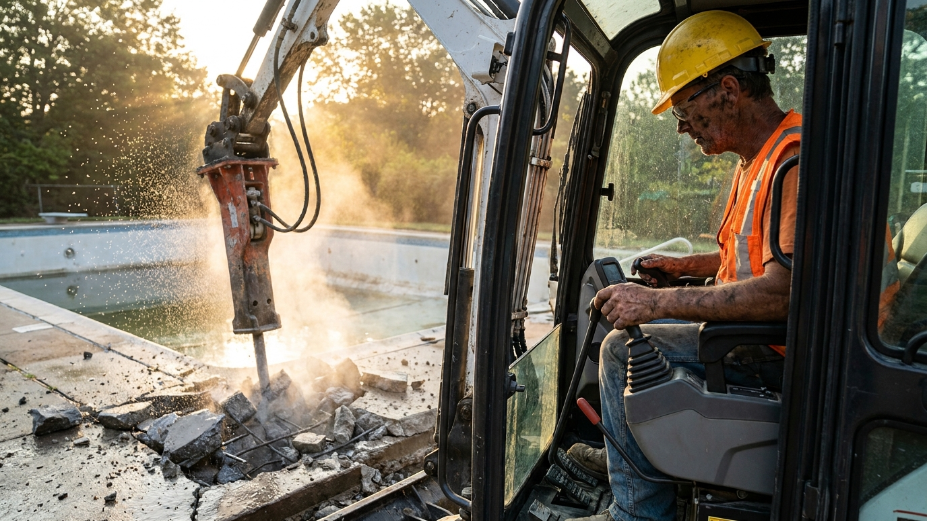
Ask for the method step by step: where the water goes, how the bottom is opened for drainage, what fill material is used, how thick each layer is, and how compaction is checked. Vague answers like “we fill it with dirt” are a warning sign, because poorly placed fill can settle for years.
Pool water should never go into the street or a storm drain, as the West Valley Clean Water Program explains. For the fill, Danville’s guidelines call for drainage holes about 2 inches across and roughly 2 feet apart, and fill compacted to 90% in 12-inch layers. Other cities set their own numbers, so ask which standard applies to your address.
Also ask who calls 811. USA North 811 requires at least two working days’ notice before excavation, so buried gas, electric and water lines are marked before the machine starts digging.
The written contract should name the method, what is removed, what stays buried, the fill and compaction standard, the permit and inspection responsibilities, hauling, final grading, the payment schedule and the warranty. In California, the down payment on a home improvement contract is limited to 10% or $1,000, whichever is less.
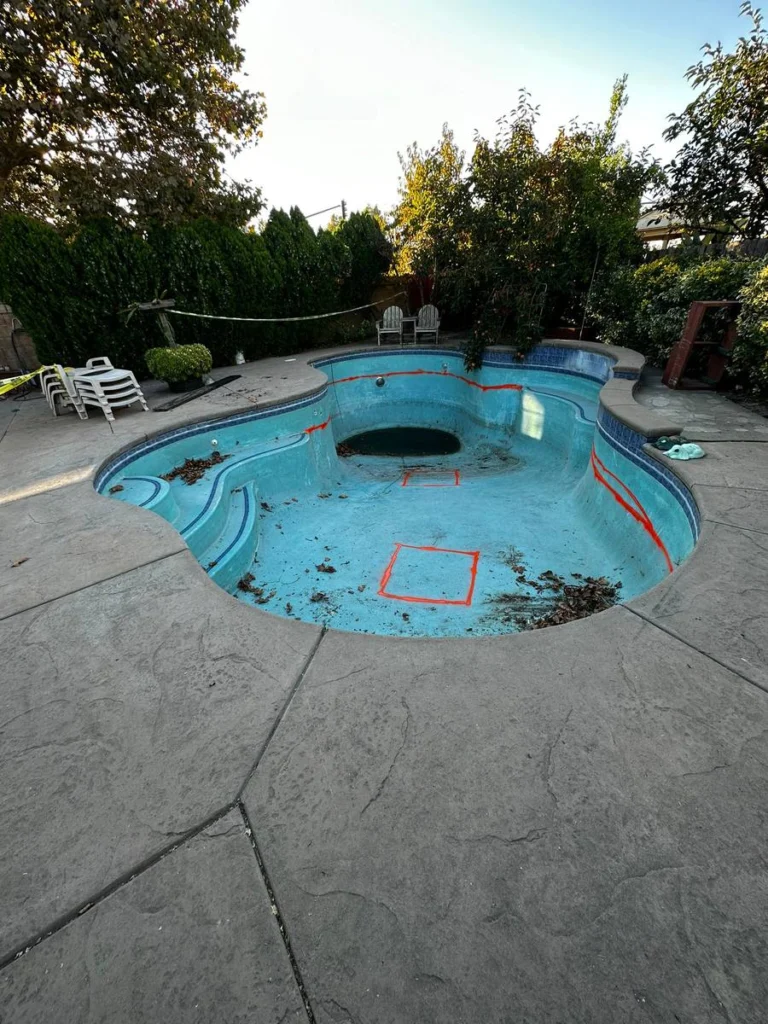
That down payment limit comes from the CSLB prescreening checklist. The CSLB also explains what a home improvement contract must contain. Use the table below to compare bids line by line.
| # | Question to ask | What a solid answer includes |
|---|---|---|
| 1 | What is your CSLB license number? | A number you can verify online, matching the business name on the bid |
| 2 | Who does the work on site? | The company’s own crew, or named subcontractors |
| 3 | Who pulls the permit? | The contractor, for your specific city or county |
| 4 | Which inspections are required? | The number and timing your building department sets |
| 5 | Partial or full removal, and why? | A recommendation tied to your future plans and local rules |
| 6 | Where does the pool water go? | A legal discharge point, never the street or storm drain |
| 7 | Who calls 811? | The contractor, at least two working days before digging |
| 8 | How is the bottom opened for drainage? | Holes or breakage that meets your city’s standard |
| 9 | What fill goes in, and in what layers? | Named material, lift thickness and a compaction target |
| 10 | Will I get a compaction report? | Yes when the city requires it, and always if you may build later |
| 11 | What happens to the deck, equipment and lines? | Removal or capping of decking, pumps, gas and electrical |
| 12 | How will you protect fences, trees and neighbors? | An access plan, plus who repairs any damage |
| 13 | What is excluded from the price? | A written list of exclusions and a change-order process |
| 14 | What is the payment schedule? | A down payment within the legal limit, then payments tied to progress |
| 15 | What warranty do you give, in writing? | Length, coverage and exclusions spelled out in the contract |

Ask what the yard will look like on the last day: rough-graded dirt, topsoil ready for planting, or a finished surface. Many bids stop at backfill. If you want a patio, lawn, turf or pavers, find out whether the same company can build it, or whether you need to hire and schedule a second contractor.
At Cicarelli Contractors, one crew handles both the demolition and the new surface, from paver patios to artificial turf. One Google reviewer had a vinyl pool and deck removed and finished with artificial turf. Another had a concrete pool removed and pavers installed around a new garden.
Ask about the warranty too. We give a 1-year workmanship warranty from the date of completion on general construction and concrete work, written into the contract. See our warranty and maintenance page for details.
The biggest red flags are a contractor who says no permit is needed, a bid with no fill or compaction details, a license number that does not match the business, a large cash deposit up front, and a quote with no written exclusions. Any one of these can turn a cheap bid into an expensive problem.
A fast schedule is not a red flag by itself. One Google reviewer told us we finished in 4 days when others had quoted 2 weeks. What matters is that the schedule includes the inspections your city requires. Another reviewer noted that our team handled the permit and delivered the compaction report on a fiberglass pool removal.
If you are still deciding whether to remove the pool at all, read our comparison of pool demolition vs. fill-in first.
Get at least two or three written bids from licensed contractors, verify each CSLB license number online, and compare the bids line by line. Look for a named removal method, permit responsibility, a fill and compaction standard, a payment schedule within California’s down payment limit, and a written warranty. Reviews that mention permits and inspections are a good sign.
In most Bay Area cities and counties, yes. Contra Costa County requires a permit to demolish or abandon a pool, and Danville and Millbrae publish their own pool demolition rules. Requirements differ by address, so ask your contractor to confirm the permit, the required inspections and any grading permit with your local building department.
Partial removal breaks out the top section of the pool, punches drainage openings in the bottom, and fills the rest in place. Full removal hauls out the entire shell before backfilling. Partial removal suits lawns and gardens in many cities, while full removal is usually the safer choice if you plan to build on the area later.
You can keep and maintain it, fill it in with a partial removal, or remove it completely. If the pool is costly to run or takes up most of the yard, removal frees space for a lawn, patio or future project. Decide what you want the area to become first, because that choice drives the right removal method.
Ask before you sign. Some cities require an engineering compaction report at the final inspection, especially for full removals or areas that may be built on later. Cicarelli Contractors provides the engineering compaction report on full removals when the city requires it. Even when not required, the report is a useful record for future buyers.
In California, the down payment on a home improvement contract is limited to 10% of the contract price or $1,000, whichever is less, according to the CSLB. After that, payments should follow completed work, such as demolition, backfill and final inspection. Be cautious with any contractor who asks for a large deposit or cash before work starts.
Bring these 15 questions to every contractor you talk to, and ask for the answers in writing. A clear bid makes the comparison easy and protects you if something goes wrong later.
Cicarelli Contractors removes concrete, gunite, fiberglass and vinyl pools across nine Bay Area counties, and we answer every one of these questions in our written estimate. Send us a few photos of your pool and yard, and request a free, written estimate within 24 hours.