
Building an ADU on a Former Pool Site in the Bay Area: What the Ground Needs
Planning an ADU where your pool is or was? Here is what the ground needs: full removal, engineered fill, a compaction report and the…
Quick answer
Pool demolition cost depends mainly on the removal method (partial fill-in or full removal), the pool’s size and material, backyard access, hauling and fill, and your city’s permit and engineering rules. Angi’s national guide, updated October 12, 2026, puts full removal at $4,000 to $16,000 and a partial fill-in at $2,500 to $10,000, but only an itemized, written quote for your own pool gives a reliable number.
Related service: Pool removal services
If you are a Bay Area homeowner pricing out an unwanted pool, you have probably seen ranges so wide they are hard to use. That is not because contractors are guessing; it is because the work changes a lot from one backyard to the next.
This guide explains what actually moves the price, using what we see when we quote pool removal jobs at Cicarelli Contractors and the published rules of Bay Area cities. It will not give you a Cicarelli price list, because we quote each pool individually. It will help you read and compare quotes with confidence. For service details, see our pool removal page.
National cost guides give a starting point, not a Bay Area quote. Angi’s cost guide, last updated on October 12, 2026, lists a $6,000 national average for pool removal, with most homeowners spending $5,000 to $8,000; by method, a partial fill-in runs $2,500 to $10,000 and a full removal $4,000 to $16,000. Local labor, disposal, access and permit requirements push individual projects above or below those figures.
Two pools of the same size can be priced very differently. A flat lot with a wide driveway lets an excavator and dump trucks work efficiently. A hillside lot with a narrow side gate may mean smaller machines, more hand labor and more trips. A city that requires a soils engineer’s report adds a cost that another city may not.
That is why we treat national numbers as context only. The figures above are Angi’s national data, not a Cicarelli quote and not a Bay Area average.
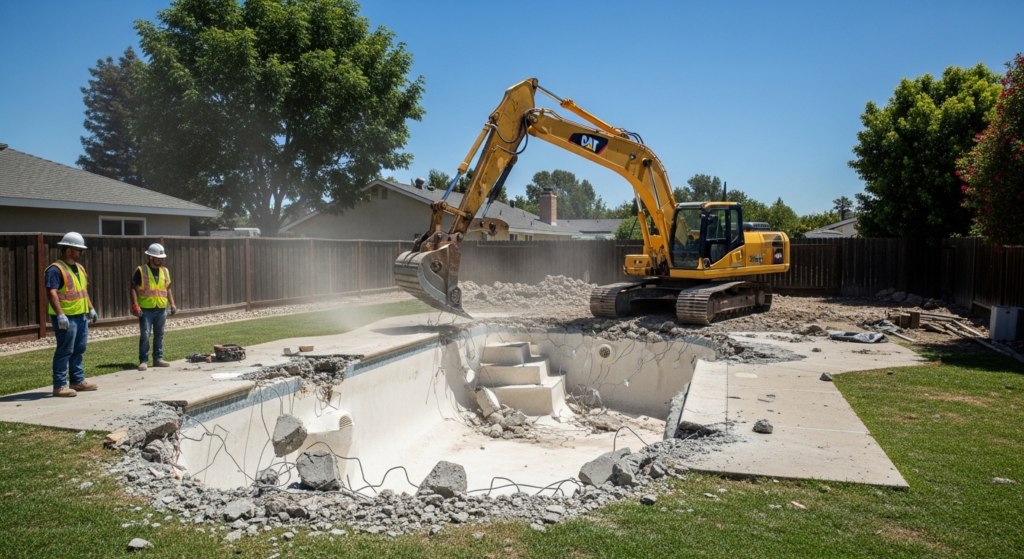
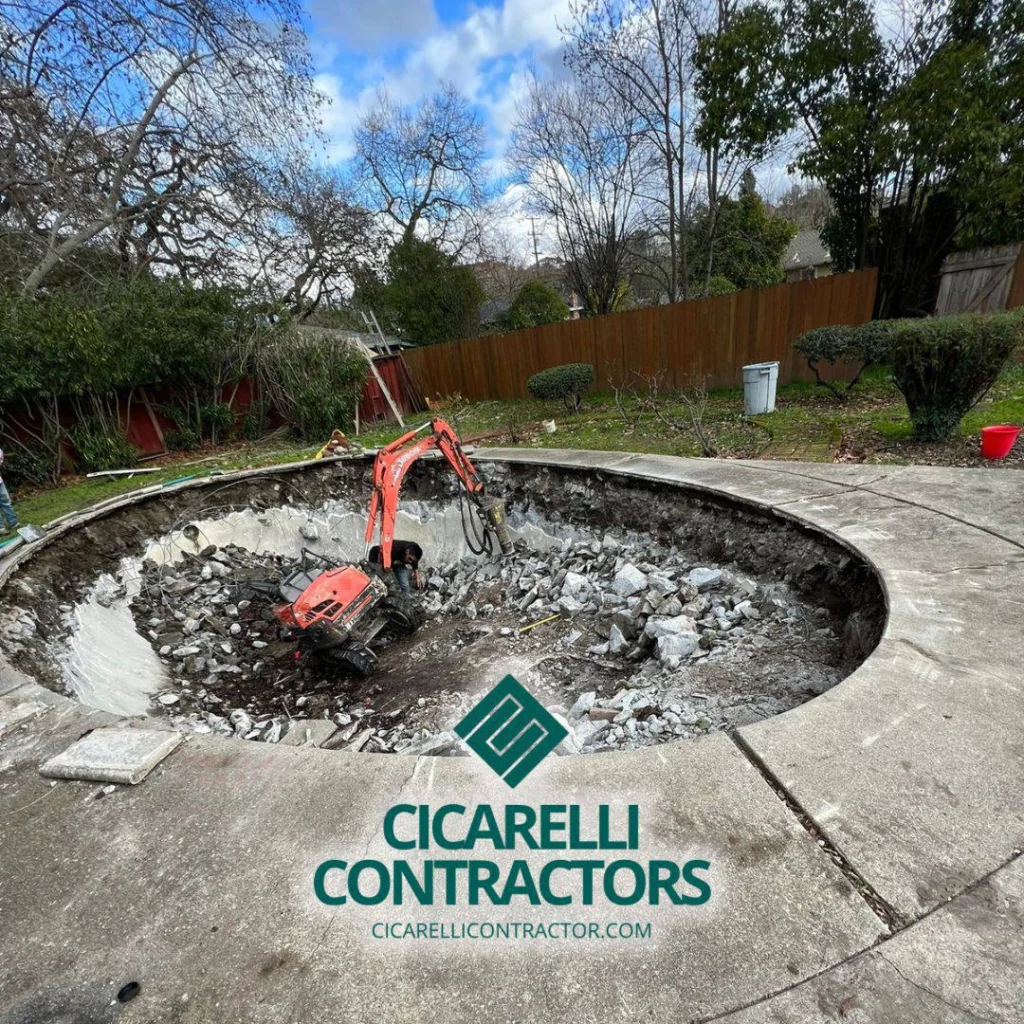
The removal method is usually the biggest single cost driver. A partial removal (fill-in) breaks out the top of the shell, opens the floor for drainage and fills what remains. Full removal breaks and hauls the entire shell, then fills a larger empty excavation. More concrete out and more fill in generally means a higher total.
Angi describes full removal as costing twice as much or more than a partial fill-in. The gap comes from three line items: demolition time, hauling and disposal of concrete, and the volume of imported fill. Full removals are also more likely to need a compaction report from a soils engineer.
Your city may decide the method for you. Millbrae, for example, allows partial removal only for landscape or garden areas and requires complete removal under a structure, driveway, patio or deck, according to its pool and spa demolition requirements. If you plan an ADU or addition later, full removal now is usually cheaper than digging out a buried shell after the yard is finished. Our comparison of pool demolition or fill-in covers the tradeoffs.
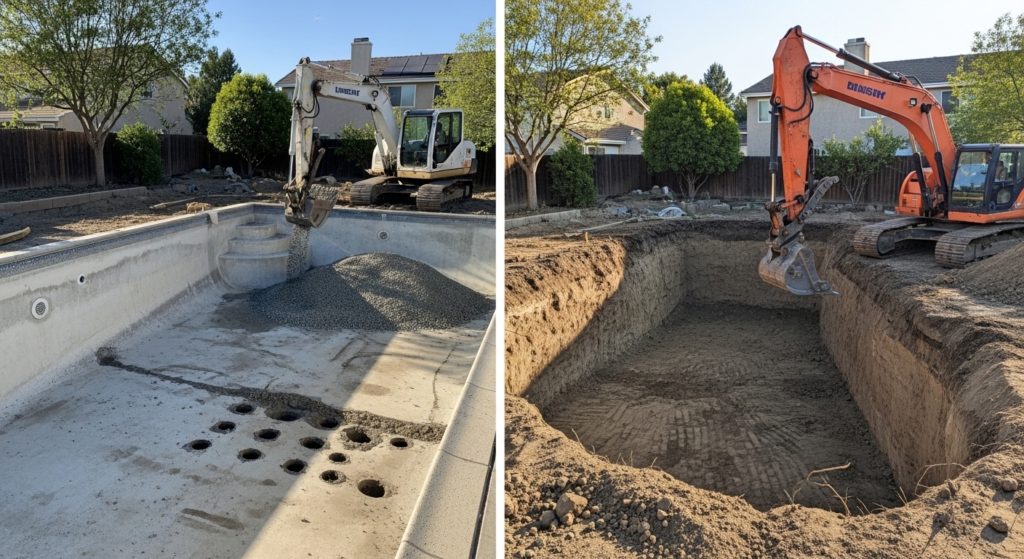
After the removal method, access and the pool itself drive most of the difference between quotes. Narrow or sloped access slows every step, while larger, deeper or heavily reinforced pools mean more concrete to break and haul. Spas, thick decks, retaining walls and equipment pads add work. Soil, drainage and how far debris must travel also matter.
| Cost factor | Why it matters | What to ask the contractor |
|---|---|---|
| Access | Narrow gates, stairs or slopes mean smaller machines and more labor | What equipment fits, and is any fence or gate removal included? |
| Pool size and depth | More shell to break and more fill to import | What dimensions and depth is the quote based on? |
| Shell material | Concrete or gunite breaks differently than fiberglass or vinyl | Is the whole shell removed, or only part? |
| Deck, spa and extras | Each adds demolition and hauling | Are the deck, coping, spa and equipment pad included? |
| Hauling and disposal | Concrete is heavy and every truckload costs money | Are disposal fees in the price? |
| Fill and compaction | Imported fill and layer-by-layer compaction take time and material | What fill material, and how is compaction verified? |
| Finished surface | Topsoil, turf, pavers or planting are separate work | Does the price stop at rough grade or include a finished surface? |
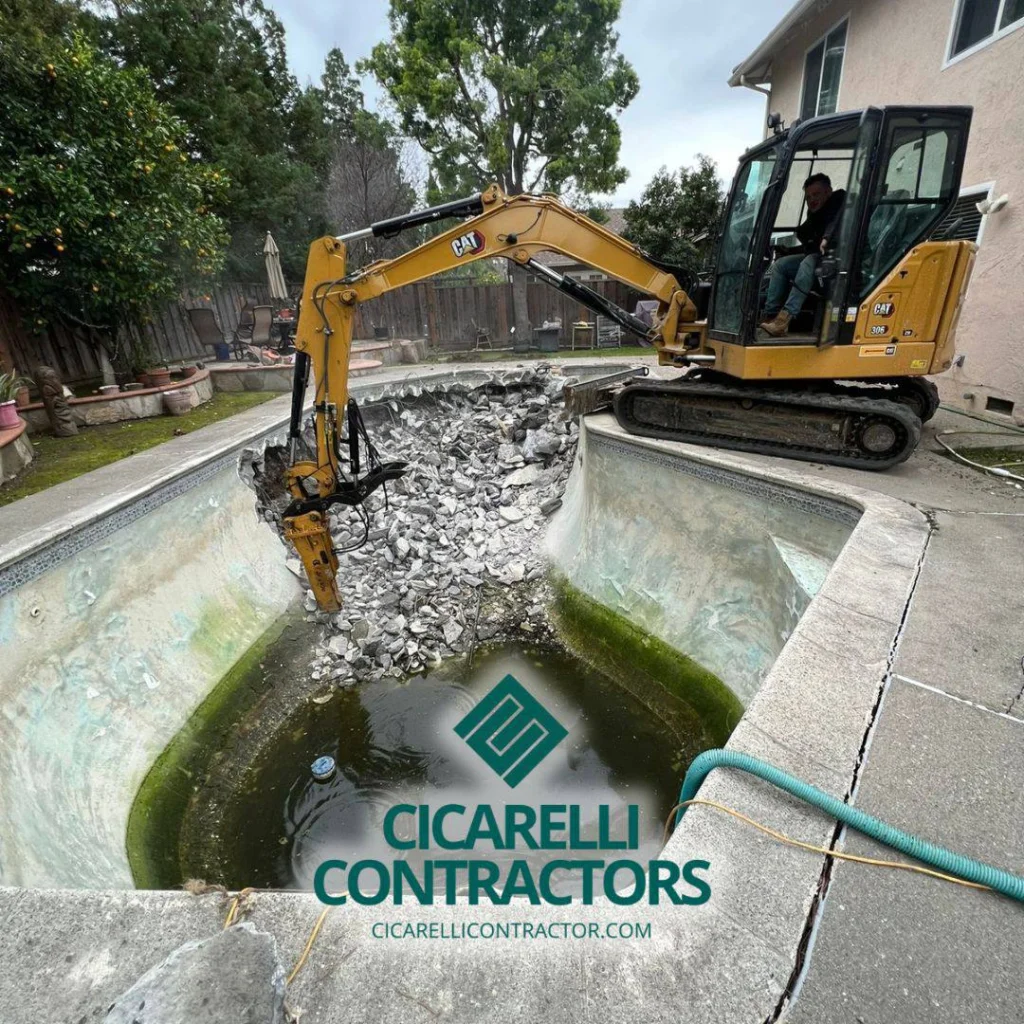
Hillside jobs deserve a special note. One Google reviewer described a hillside pool with difficult access where our crew moved fill by wheelbarrow in 90-degree heat. That kind of site takes more labor than a flat yard, and an honest quote should say so up front.
Expect a city permit fee, at least two inspections in many cities, and, for full removals or future building sites, possibly a soils engineer’s compaction report. Some jurisdictions also require a grading permit. These costs vary widely by city, so ask each contractor whether permit fees, engineering and inspection visits are included or billed separately.
Published examples from Bay Area jurisdictions:
We pull the demolition or building permit, schedule the inspections and, on full removals, provide the engineering compaction report when the city requires it. Read our pool demolition permit guide for more on the paperwork.
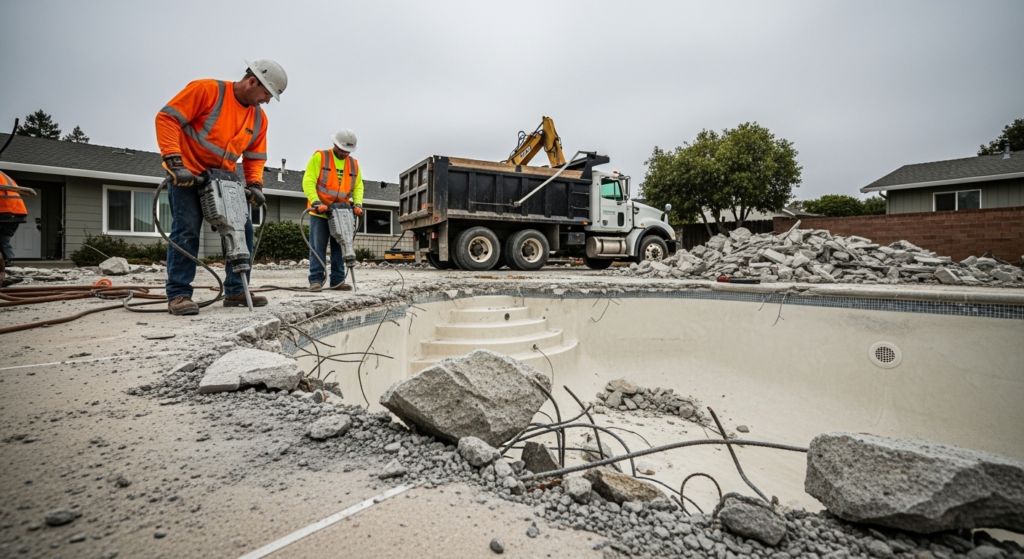
A useful quote is written, itemized and specific about the method. It should name partial or full removal, list what is demolished and hauled, the fill material and compaction method, who handles permits and inspections, whether an engineering report is included, and where the work stops: rough grade, topsoil or a finished surface. Vague quotes are hard to compare.
Use this checklist when you line up quotes side by side:
Also confirm the contractor’s license on the CSLB site. Our license is CSLB #1109419, B General Building. Our list of questions to ask a pool demolition contractor goes further.
The most reliable savings come from choosing the right method the first time, preparing the site, and keeping demolition and the new surface with one crew. Clear the access path, decide what the space will become before work starts, and compare quotes that cover the same scope. A low quote that leaves out permits or disposal is not a saving.
A few practical steps help:
Price is not the only measure. One Google reviewer had a fiberglass pool removed and filled quickly, with the permit and compaction report handled, and felt the price compared well with other quotes. Another noted we finished in 4 days when others had quoted 2 weeks. Your project will differ, but scope and schedule should both be clear in writing.
There is no single California price. Angi’s October 2026 data gives a statewide range of $3,500 to $8,000, against national ranges of $2,500 to $10,000 for a partial fill-in and $4,000 to $16,000 for a full removal. Bay Area projects vary with access, pool size, disposal, permits and engineering, so an itemized quote for your own pool is the only reliable figure.
It is a significant project because it involves heavy equipment, hauling, imported fill, compaction, permits and inspections. Partial removal usually costs less than full removal. Easy access, a smaller pool and a city with simple requirements keep costs down, while hillside lots, large decks and engineering reports push them up.
Usually, yes. Partial removal leaves the lower shell in place, so less concrete is broken and hauled and less fill is needed. Angi describes full removal as costing twice as much or more. The tradeoff is that many cities limit a partially removed area to landscaping, so it may not suit future building plans.
It depends on your city and the method. Mountain View requires a compaction report from a California licensed geotechnical or soils engineer at final inspection, while other cities ask for one mainly on full removals or future building sites. Ask each contractor whether the report is included in the quote when the city requires it.
Not always, so check the written scope. A complete quote should list the deck, coping, spa and equipment pad separately and say whether hauling for each is included. If the deck stays, ask how the contractor will protect it during demolition and what happens where the deck meets the new fill.
A permitted partial removal is usually the lowest-cost legal option for yards that will stay lawn, turf or garden. Skipping the permit or burying a shell without proper drainage openings may look cheaper but can lead to settling, failed inspections and problems when you sell or apply for future permits.
National ranges only go so far. For a number you can plan around, send us photos of your pool, access and equipment pad.
We serve all nine Bay Area counties, from Contra Costa County to Santa Clara County. Request your free, written estimate and we will send it within 24 hours.